Guide
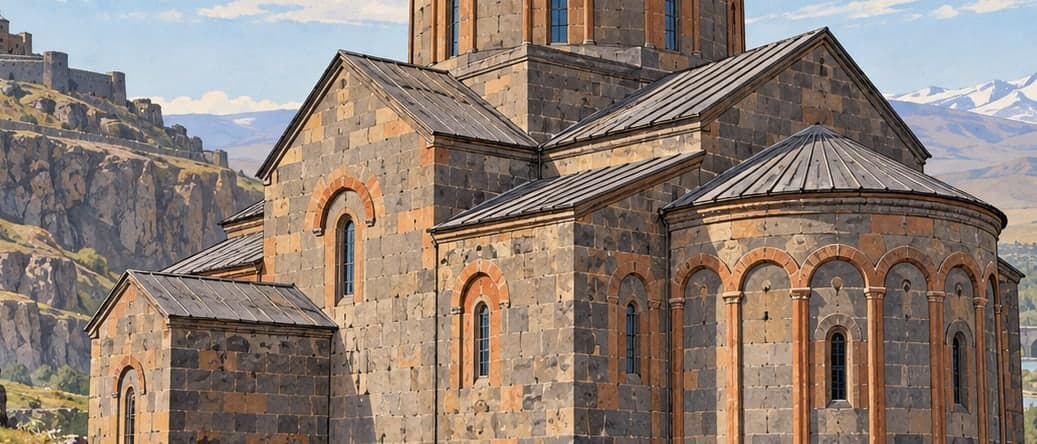
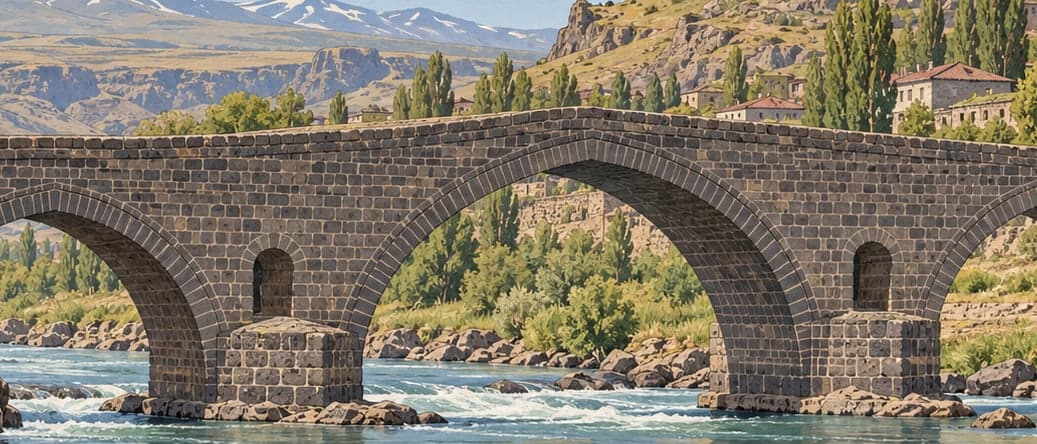
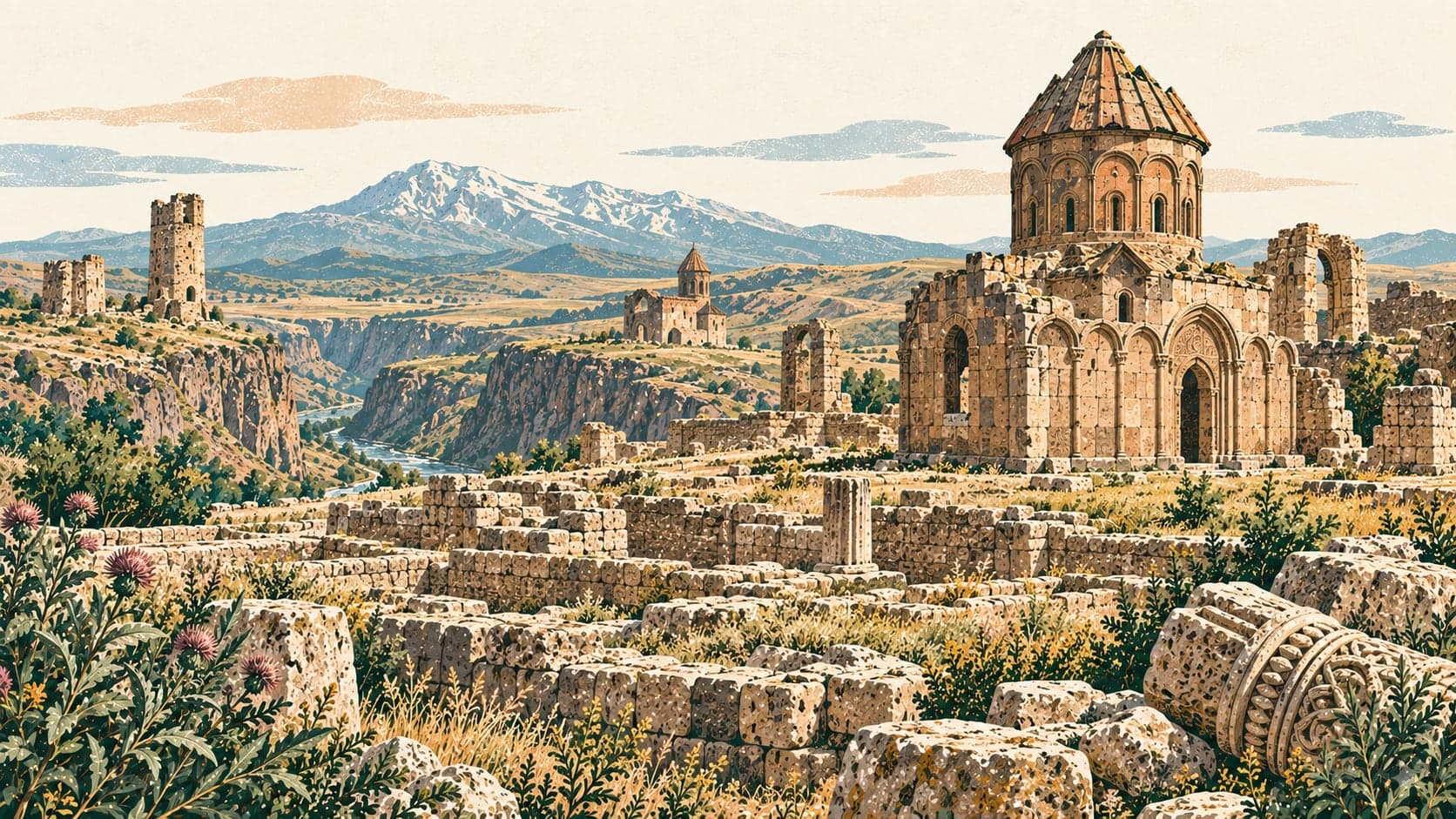
Ani is an archaeological site southeast of Kars, along the Arpaçay river. An important settlement since the Iron Age, it belonged first to the lands of the Nairi and the Urartians, peoples native to Anatolia, and was later taken by the Armenians. Between 961 and 1045 it served as the capital of Armenian rulers of the Bagratuni dynasty. The site also holds works of Islamic architecture from the eleventh and twelfth centuries. Placed on UNESCO's Tentative List in 2012, Ani was inscribed as World Heritage in 2016.
The history of the city reaches back to the Early Iron Age, between 1200 and 1000 BC. In Urartian times the surrounding region was known as Akhuriani. Excavation has brought to light Bronze and Iron Age settlement and structures that may be Urartian. The walls of the inner fortress contain reused classically cut stone, and there is a building that may have been a Zoroastrian fire temple. Chroniclers first mention Ani in the fifth century AD, as a strong castle built on a hill and the property of the Kamsarakan family.
The name appears at the earliest in the sixth century, as a fortified place belonging to Armenian lords of the Kamsarakan line. The long struggle between the Kamsarakan and the Bagratuni ended in victory for the latter, and in 780 the Kamsarakans sold their properties to the Bagratunis and moved into Byzantine territory. In 885 Ashot I of the Bagratunis was recognised by the Abbasid caliph and the Byzantine emperor as king of Armenia. Ashot and his sons ruled first at Bagaran, then at Shirakavan and at Kars, until in 961 Ashot III moved his capital to Ani and began building a great city there.
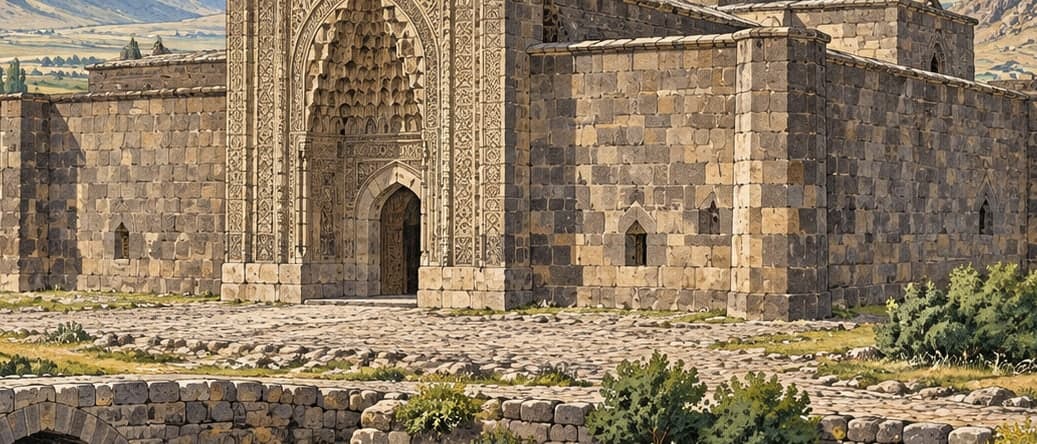
The city flourished most under Smbat II, who ruled from 977 to 989, and his son Gagik, who ruled until 1020; its population in those years is said to have passed a hundred thousand. When the Byzantines seized Ani in 1045 and ended the Bagratuni state, the region was left undefended and unsettled, and in 1064 it surrendered to the Seljuk sultan Alp Arslan. The ruined walls were rebuilt and inscriptions recording the repairs were added, carrying motifs of lions, dragons and double-headed eagles. Shortly after the Seljuk conquest the city and its surroundings became the capital of the Shaddadid emirate, of Kurdish origin. The most important Islamic monument at Ani, the mosque of Abu'l Manuchihr, was built in 1072 by the Shaddadid emir Manuchihr.
Around 1190 the Georgian lord Zakare Mkhargrdzeli made the citadel of Ani his base and established a domain covering the Kars and Ahıska regions. His descendants ruled as atabegs, first under the Georgian kings in Tbilisi and later under the Mongol Ilkhanids. Many of the Christian monuments at Ani were built or repaired in that period. The city afterwards came under the Jalayirids and the Kara Koyunlu, but its population remained largely Armenian. An earthquake in 1319 caused heavy damage, and Timur later took and destroyed the city. Even so it was not completely abandoned until the Ottoman-Persian war of 1535.