Guide
In the old Kırkçeşme quarter, on the Golden Horn side of the Valens aqueduct, stands a small complex of medrese, tomb and sebil. Its founder was Gazanfer Ağa, a chief white eunuch of the palace under Mehmed III, of Hungarian origin, who was executed in January 1603; his endowment deed of January 1596 records that he built the medrese and the sebil, and that he had a tomb made for himself beside them. Since the work was carried out in the years when Davud Ağa was chief court architect, the complex is thought to be his.
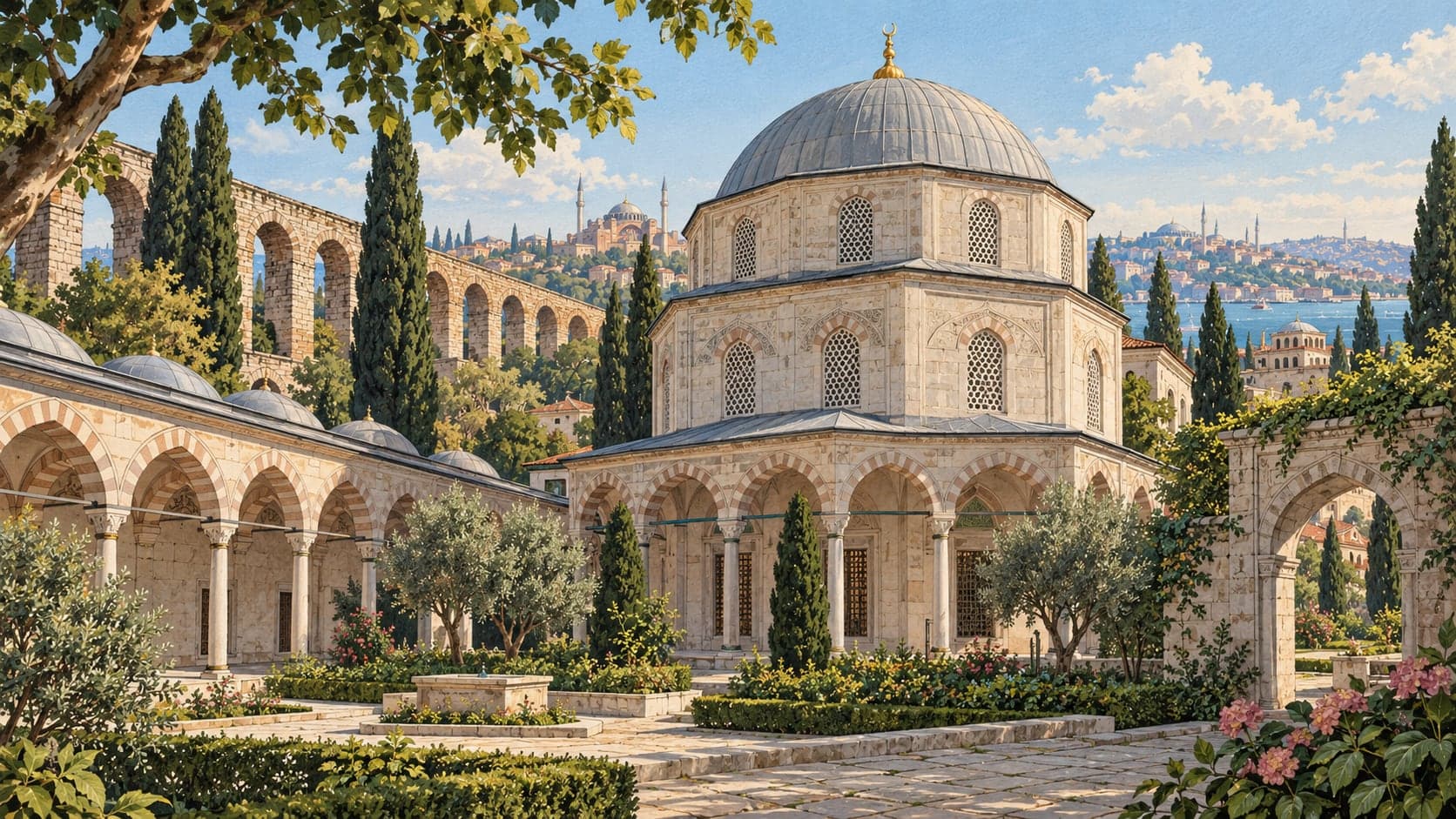
The tomb rises at the north-west corner of the outer courtyard, faced in cut stone, twelve-sided and domed. It is lit by two rows of windows, with cupboards set between the windows of the lower row, and traces of painted decoration survive inside above them. Besides Gazanfer Ağa's own, two women's cenotaphs stand here. In the courtyard around the tombs a small burial ground of some ten graves grew up, the earliest dated 1616.
The sebil at the north-east corner of the same wall is worth the few steps: eight-sided, with five of its faces projecting into the street, marble columns with muqarnas capitals carrying pointed arches of two-coloured stone, stone lattices cut within the arches and cast bronze grilles below them, a wellhead inside and moulded plasterwork in its dome. It was in a ruinous state until the repair of 1943, when the wide eave was added.