Guide
The Galata Mevlevi Lodge was founded on the slopes above Galata in 1491, and over four centuries it was known by three names — Galata Mevlevihanesi, Kulekapisi Mevlevihanesi and Galipdede Tekkesi. It has been rebuilt more than once. A repair inscription of 1651 records that the kitchen superintendent İsmail Efendi restored buildings that had probably been damaged in the 1509 İstanbul earthquake, the one remembered as the 'Lesser Apocalypse'; after the Tophane fire of 1765 Sultan Mustafa III appointed Yenisehirli Osman Efendi to rebuild it.
The poet Şeyh Galib became head of the lodge in 1791, and his friendship with Sultan Selim III brought another renovation. The lodge took its final form during building work between 1851 and 1859, under Sultan Abdülmecid. After the closure of the dervish lodges in 1925 the building served for a time as a primary school; work between 1967 and 1975 turned it into the Museum of Divan Literature, and after renovation and landscaping between 2008 and 2011 it reopened as the Galata Mevlevihanesi Museum.
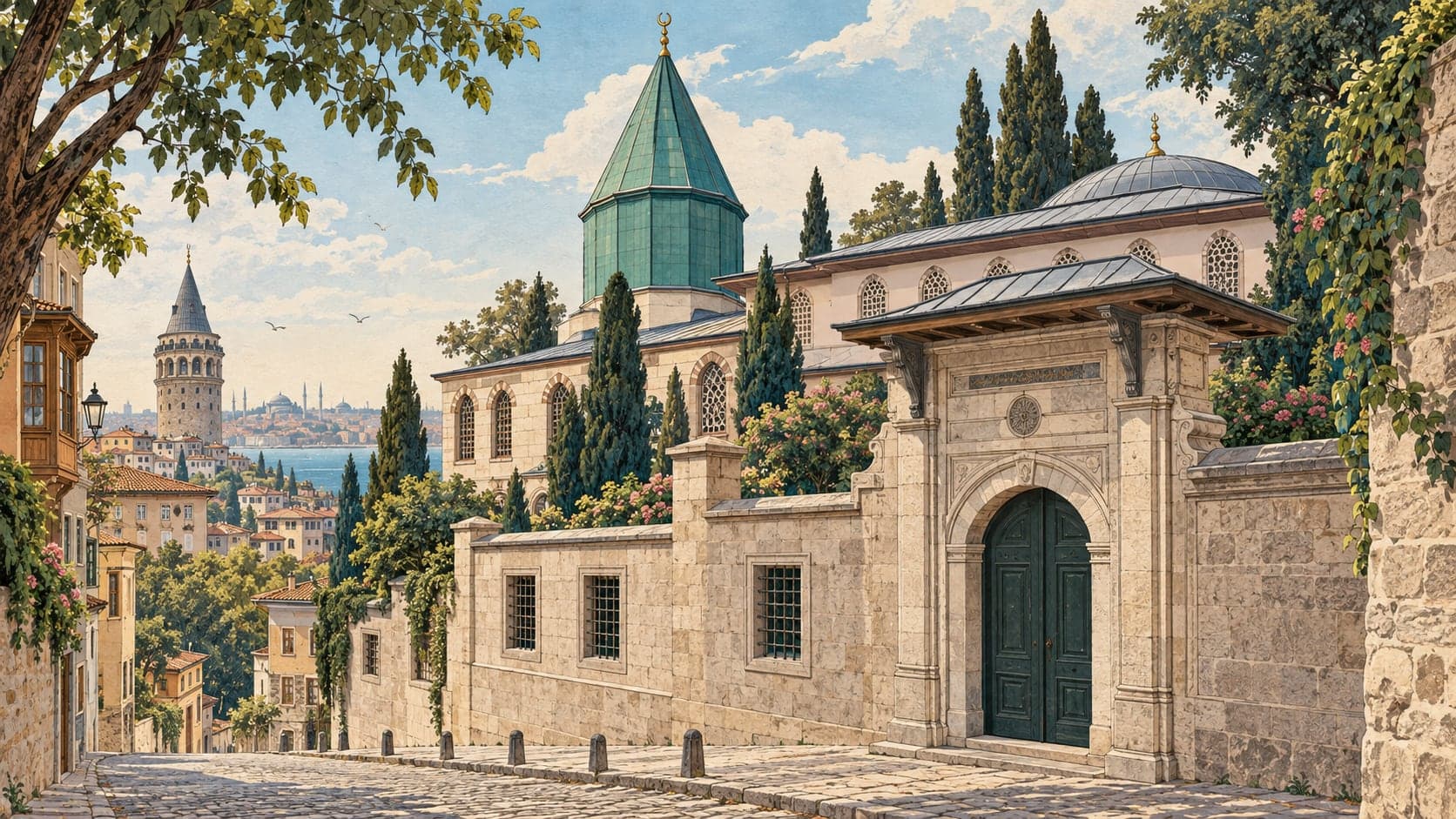
The displays are in the semahane, the hall built for the whirling ceremony. The dervish cells on the lower floor cover Sufism, the objects of the order, the history of this lodge, and the fine arts; the entrance floor is the sema floor itself; the galleries above hold calligraphic panels and musical instruments. Outside the exhibition rooms the site also holds the main gate, the tombs of Şeyh Galib and Halet Efendi, the sebilkuttap — a combined fountain, timekeeper's room and library — and the burial ground known as the Hamusan, 'the silent ones'.
Two practical points. The museum states that while a temporary exhibition is being prepared, the parts open to visitors are the two tombs, the semahane, the temporary exhibition in the former administrative building, and part of the garden. It opens at 09:00 and closes at 19:00, with the ticket office closing at 18:00, and is closed on Mondays; the address is Galip Dede Caddesi No 15, by Tünel.