Guide
Dede Korkut — Korkut Ata — is a half-legendary sage raised up and made sacred in the old epics of the Oğuz Turks: a man who knew the customs and the law of steppe life thoroughly, who kept the tribal order, and who is the bard telling the stories in the Book of Dede Korkut, the oldest Turkish epic. Historical sources and Oğuz traditions call him sometimes simply Korkut, sometimes Korkut Ata, and in western Turkish Dede Korkut.
Who he was depends on which tradition you follow. Folk narratives recorded in the Syr Darya basin present him as a baksı, a shaman, while written sources present him as a Muslim Turkish saint who served rulers as vizier and adviser. He is thought to have been a seer of the period before the Oğuz accepted Islam, taking on the identity of a saint as the culture changed with Islamisation. He is also known as the patron of Kazakh and Kyrgyz bards, and one story says he taught the Kyrgyz shamans to play the kopuz and to sing.
The historical accounts differ from one another. The oldest source mentioning Korkut Ata is the Jami' al-tawarikh of Rashid al-Din, vizier of the Ilkhanids, written with a committee in 1305, where Korkut appears as a contemporary of four Oğuz rulers. By that account he was of the Bayat tribe, son of Kara Hoca, and lived 295 years; he appeared in the time of İnal Sır Yavkuy, the ninth ruler of the Oğuz line, and served as adviser to the tenth, Kayı İnal Han, and to three rulers after him.
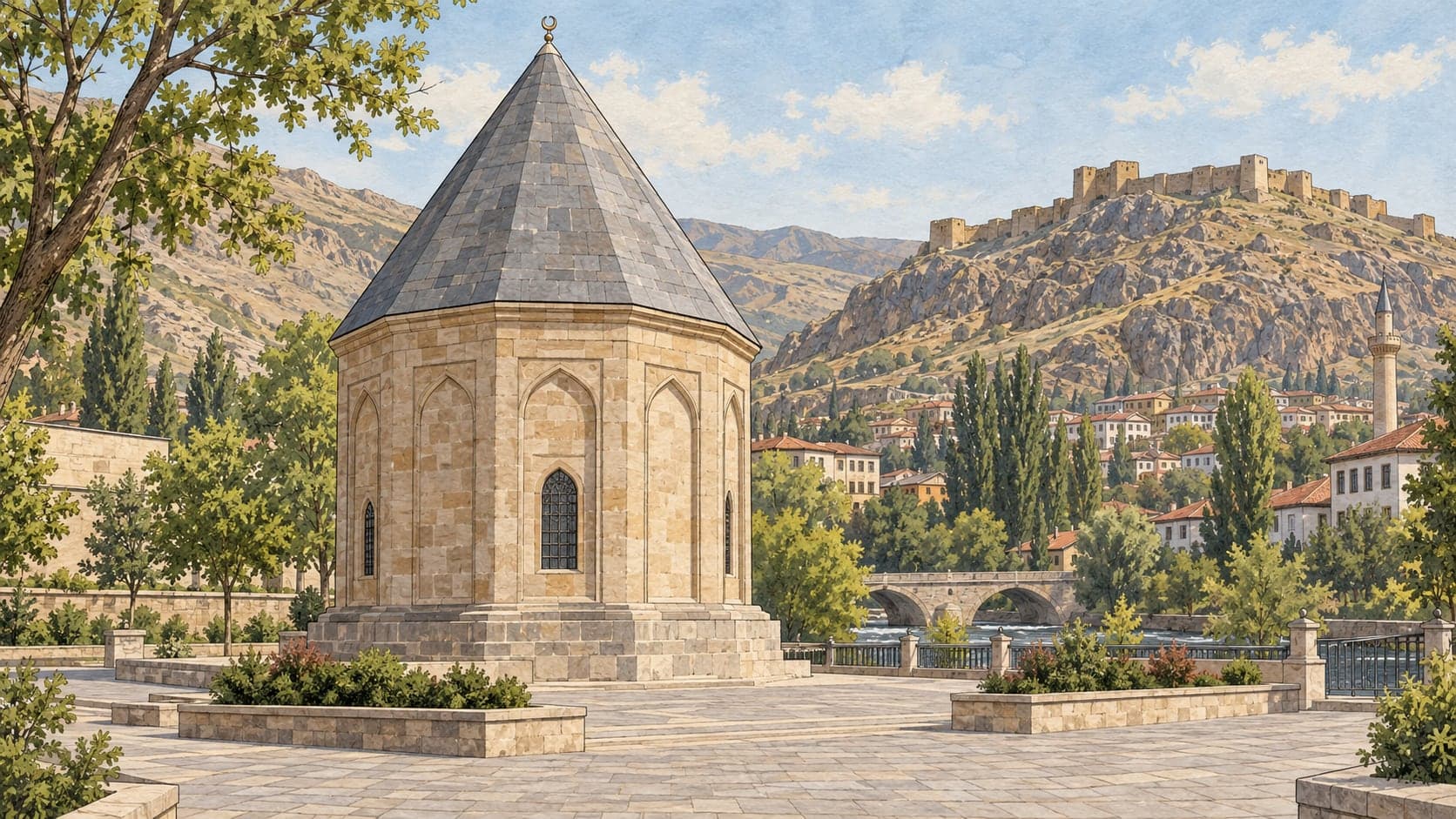
The tomb tower stands in the village of Masat — Yıldırım — in the central district of Bayburt, south-east of the town, and is known locally as the Ali Baba or Korkut Ata tower. There is no information about when it was built; it is said to date from the middle of the ninth century. It is circular, made of cut stones of differing sizes laid one above another in various ways.