Guide
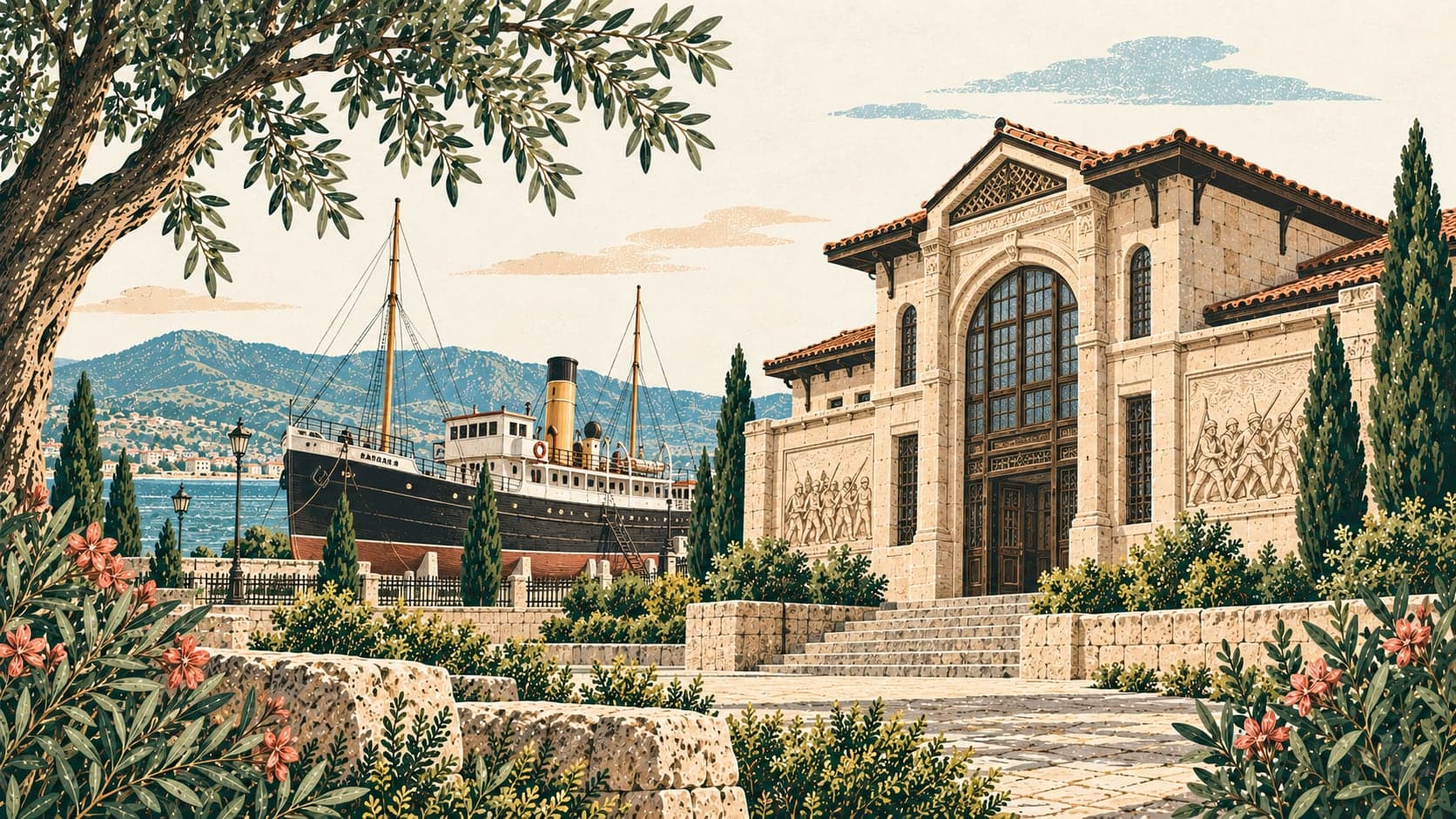
The ship you board at Samsun is not the original. The Bandırma was broken up for scrap in 1925, and what stands here was built to her exact dimensions in 300 days, on a decision taken in 1999 by the then governor of Samsun and carried out by the metropolitan municipality and the provincial special administration. It opened to the public in 2003; since 2005 the municipality has held all rights to it and has run it as a museum.
The original had a long and undistinguished career before the three days that made her famous. She was launched in July 1878 from the Phoenix yard of Paisley, McIntyre & Co. as the iron-hulled screw steamer Trocadero, a general cargo and passenger ship registered in London. She passed through owners in London and Piraeus, changing names to Kymi and then Panderma; in December 1891 a navigational error put her on the rocks off Erdek and she was written off as a total loss, only to be bought, refloated and repaired in the Golden Horn. In 1894 she was sold to the Ottoman İdare-i Mahsusa and renamed Bandırma. In the First World War she served as a transport, and in August 1915 an English submarine's torpedo missed her in the Sea of Marmara.
On the afternoon of Friday 16 May 1919 she left the Galata quay in İstanbul with Mustafa Kemal Paşa and his staff aboard, and reached the Tütün İskelesi at Samsun at eight on the morning of Monday 19 May. He spent the three-day passage in one cabin, and that cabin is the centre of the museum: a meeting is staged there with five figures, around a walnut table and chairs of the early 1900s, with a Black Sea map of 1910 worked on gazelle hide laid out on the table. The brass clock opposite his figure is fixed at eight o'clock, for the hour he stepped ashore. A double-handset telephone of the late nineteenth century hangs on the wall.
The rest follows green arrows on the deck. Amidships is the bridge, with figures of the captain İsmail Hakkı Bey, the mate Tahsin Bey of Üsküdar and the cipher clerk İsmail Bey, and the ship's compass, speed panel and other instruments. Forward is a cabin furnished as a bedroom, modelled on Atatürk's sleeping cabin aboard the yacht Savarona, holding walnut furniture of the period and an original wooden radio of the 1930s that he used. From opposite it, stairs go down into the hold, which is an exhibition space where guides — a historian, an art historian and an archaeologist — take visitors through the material.
The ship sits inside a 35,000-square-metre park and open-air museum. It holds what the directorate describes as Türkiye's longest ceramic reliefs, representing the Gallipoli battles and the drive of the enemy into the sea at İzmir; an inscription naming 1,200 men from Samsun and the surrounding districts killed in the War of Independence; nine bronze reliefs on the national struggle; and a seven-figure monument of national liberation. There is an admission charge, with a reduced rate for students.