Guide
The tomb of Aziz Mahmud Hüdayi stands on the left of Hüdâî Avlusu Sokağı in Üsküdar, on the terraced lane that climbs west from the main gate of his complex, with the mosque and assembly hall attached directly behind it. Of all the tombs of holy men in İstanbul this has been among the most visited: until 1925 the Celvetî brotherhood came here in procession on the eves of the religious festivals, led by the head sheikh, and the stream of visitors has not stopped since.
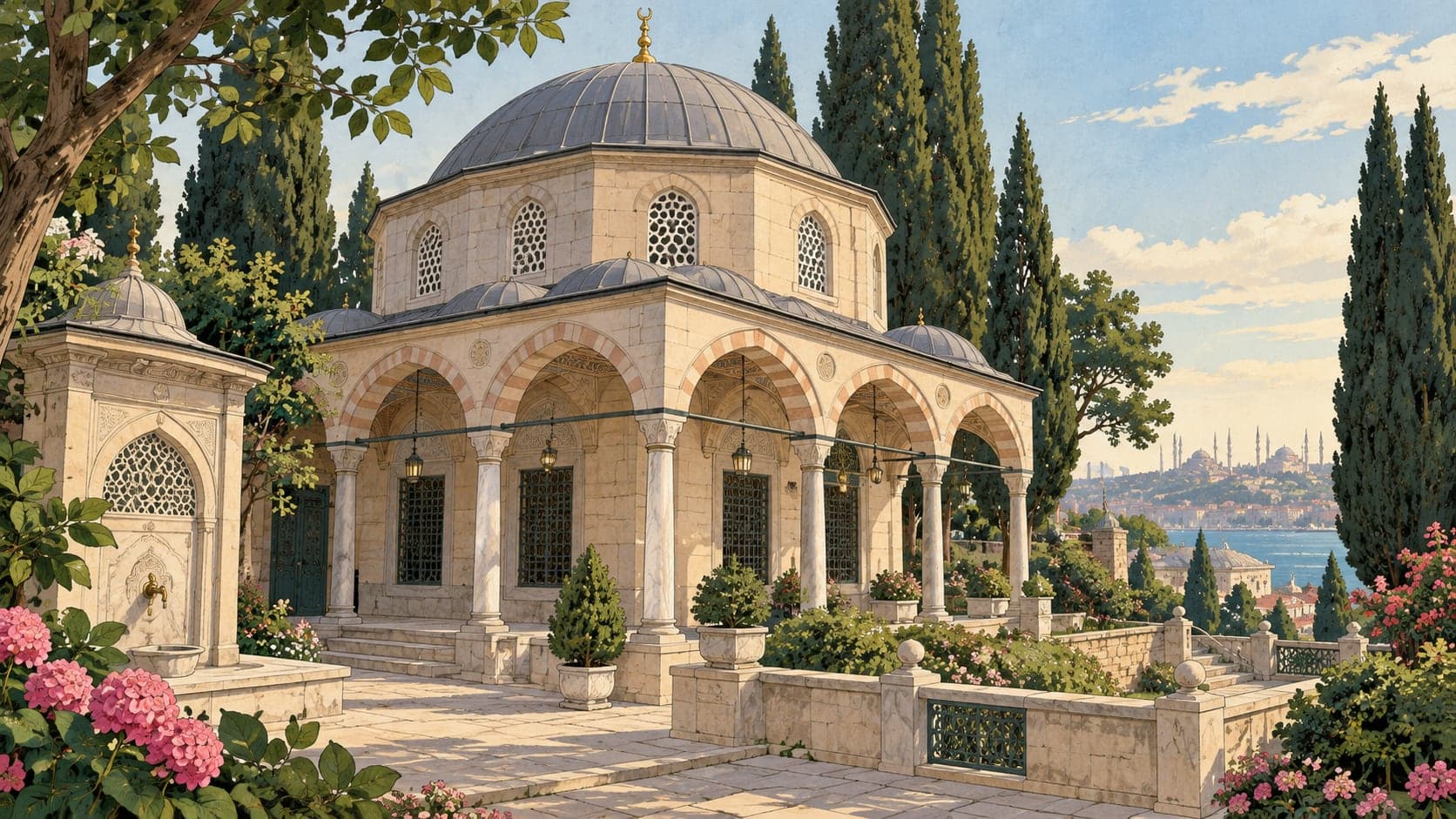
The building shares the construction and the restrained empire decoration of the mosque behind it. Three spaces follow one another from north to south: a glazed entrance section, a room under a pyramidal cap where the tomb keepers kept watch, and the chamber itself. Over the chamber door is an Arabic prose inscription in talik giving the date of death, 1628. Inside, a wooden dome rises on four round marble columns in the middle of the rectangular room, divided within into thirteen segments like the crown of the Celvetî headdress; beneath it stands the wooden cenotaph, surrounded by gilded iron grilles, with ten more around it belonging to his children and a grandchild. A band of thuluth carrying the Sûrat al-Mulk, from the hand of the calligrapher Mahmud Celâleddin, runs round the upper walls, and chests in the room hold relics of the sheikh.
East of it is a second tomb, at first an open burial ground and roofed over probably in 1855–56, where many of the lodge's sheikhs, members and their families are buried; when its roof was lost in the republican period the wooden cenotaphs were replaced with odd cement sarcophagi carrying small Latin-letter nameplates, some of them wrong. Elsewhere in the complex's burial ground are headstones remarkable for their calligraphy and carving, and west of the mosque, in another section of it, stands the open tomb of Fatma Hanım Sultan — eight octagonal marble columns with diamond capitals carrying pointed arches, the spaces between them closed with superb cast bronze grilles, which makes it exceptional among open tombs of its kind.