Guide
Arykanda lies within Arif village in Finike district of Antalya, on ground sloping south from the foot of a steep rock face known as Şahinkaya. The Lycian name Ary-ka-wanda means the place beside high rocks, and the ministry takes the fact that it reflects a native Anatolian language as showing this is one of the oldest settlements in Lycia.
It also marks the limit of what can be claimed. Late Chalcolithic and Early Bronze Age axes found here and at Limyra and Patara point to dense settlement in the region, but apart from one stone axe of the second millennium BC, the finds make it hard to take the city's history back before the fifth century BC. Coins of the local lords Kuprili and Aquwami show Arykanda under Persian rule in that century; fourth-century coins of Perikles, lord of Limyra, follow, so the city must have been under Limyra for a time and changed hands with Alexander. After his death it passed to the Ptolemies, then the Seleucids, and after the Peace of Apamea came under Rhodian control. In the second century BC it struck coins as a member of the Lycian League, and in AD 43, when Claudius ended the League, Lycia was made a province with Pamphylia and attached to Rome.
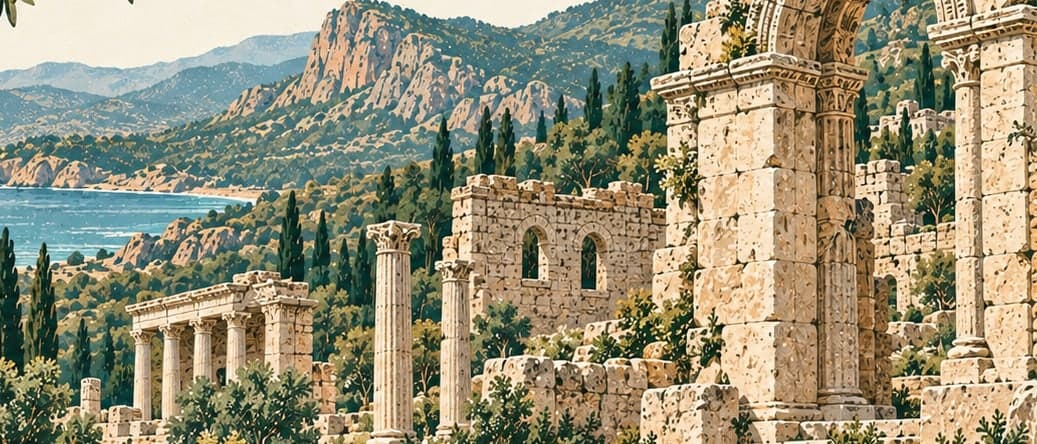
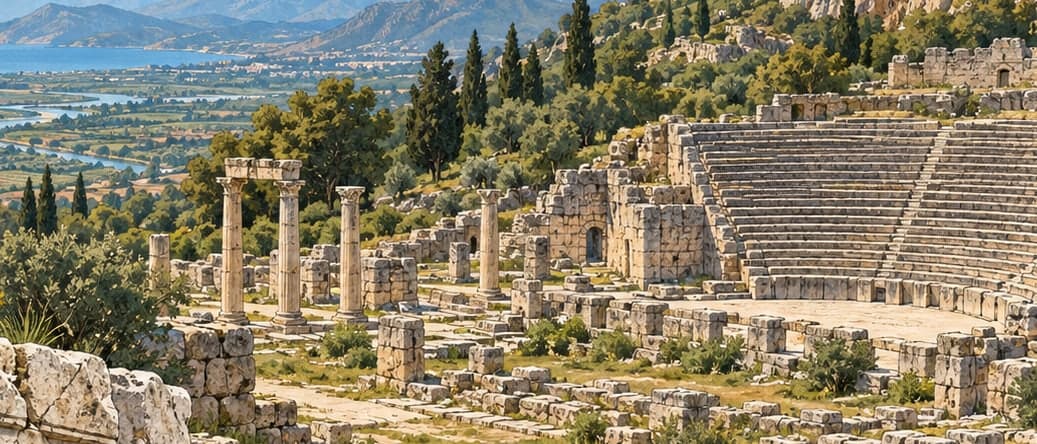
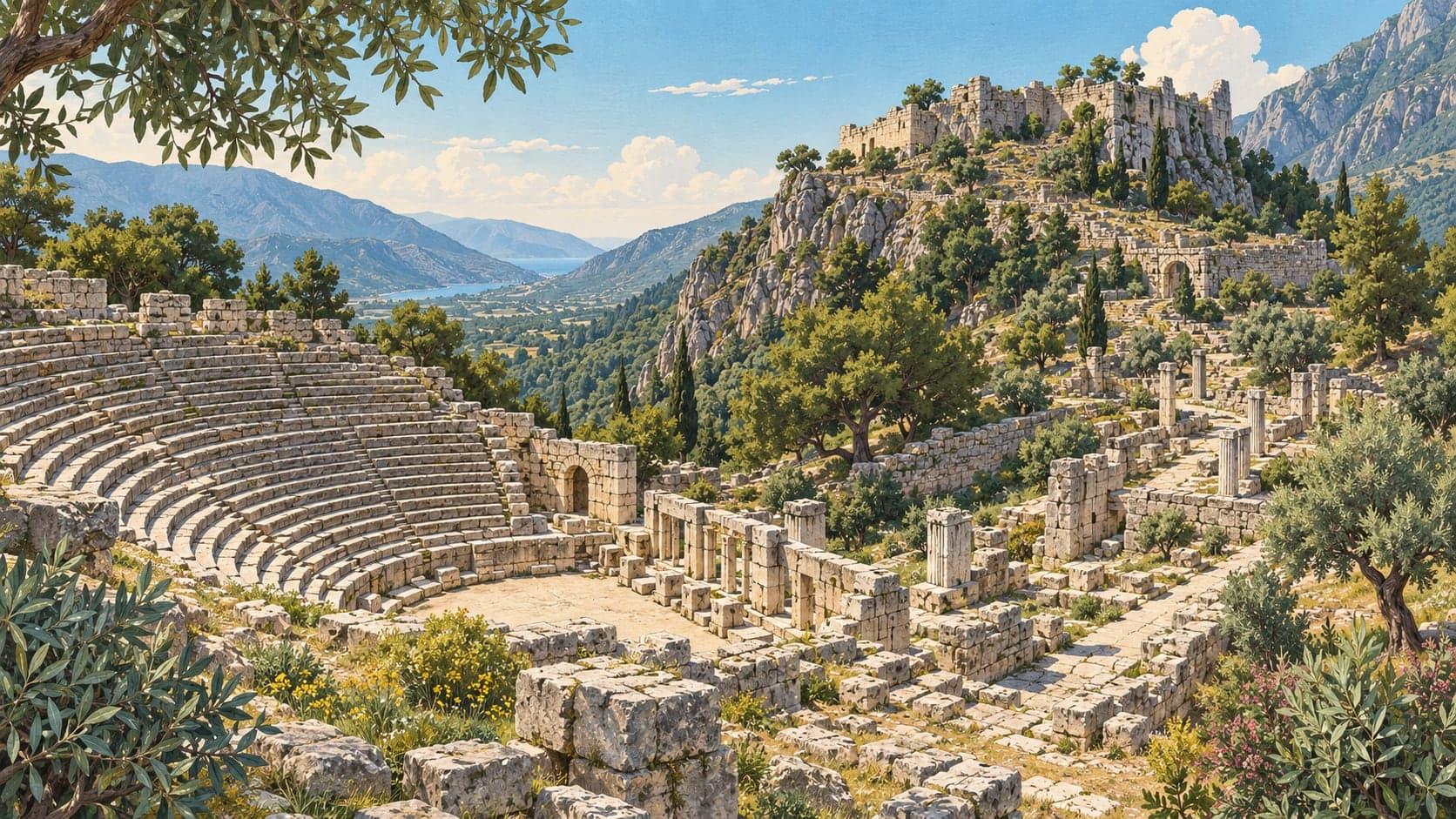
The city is built in stepped terraces, and the climb sets out its plan. Highest is a watchtower on the southwestern skirt of Şahinkaya; the triangular acropolis south of it is thought to be the first settlement. East of that stand the bouleuterion and, north of three shops beyond it, a temple of Helios built in the fourth century BC. Below the tower comes the stadium of the first century AD, with seating along one long side and the other opening to the slope. On the next terrace down is the theatre, small but the best preserved in the region; on the lowest, the agora and an odeon that also served as a council house. The gymnasium in the southeast stands next to the baths, the two reading as one building.
The East Necropolis is what draws the eye, its monument tombs largely still standing, all of the second century AD and terraced one above another; on the terrace below them the baths survive to roof height. Water came in by an arrangement the ministry describes as real engineering: four channels at separate levels cut into sheer rock where the Aykırıçay rises. A great earthquake in 240 damaged the city, which was partly repaired; under Byzantium it was called Akalanda or Orykanda, and remains and Byzantine sources show it lasted to the eleventh century, after which it may have shifted to the south of the present road. Arykanda was included in 2009 among the ancient cities of Lycian civilisation proposed for the World Heritage list — a proposal rather than an inscription.