Guide
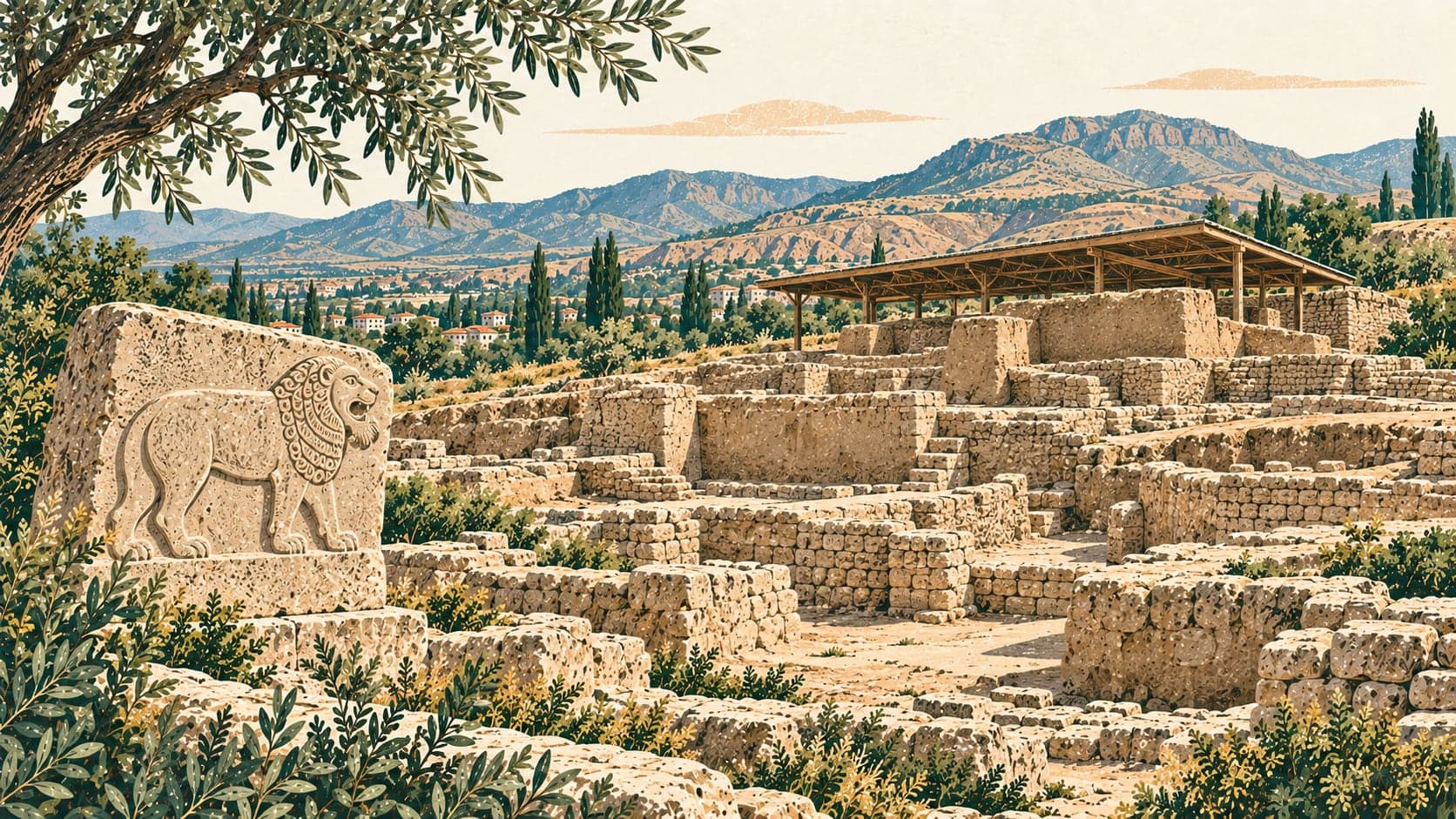
Arslantepe, also known as Melid, is an archaeological settlement seven kilometres northeast of Malatya, in the town of Orduzu, west of the Karakaya reservoir on the Euphrates. It is one of the largest mounds in Türkiye: its cultural deposit stands thirty metres high and spreads over four and a half hectares, with the settlement area measuring two hundred by a hundred and twenty metres. The mound was inhabited from about 6000 BC to the eleventh century AD. In the fifth and sixth centuries AD the area served as a Roman village, and later as a Byzantine cemetery.
Excavation began in 1932 under a French team led by Louis Delaporte and concentrated on the Late Hittite layers; the aim was to reach the capital of one of the kingdoms founded in the region after the fall of the Hittite Empire. Several deep soundings followed, but regular excavation proper began in 1961 with a group from the Sapienza University of Rome. Until the 1970s the work was directed by Alba Palmieri, and it is coordinated today by Marcella Frangipane.
The excavations have brought out more than twenty graves thought to date to 3700-3600 BC, along with the remains of six houses and two children's skeletons inside a jar; a temple of about 3600-3500 BC; a palace of about 3300-3000 BC; and a large number of seals together with finely worked metal objects. Taken together the finds show that the settlement was then an aristocratic centre of political, religious and cultural life. The seals are notable for showing that it was also a centre of trade. Apart from the pieces displayed at the Museum of Anatolian Civilizations in Ankara, the finds are shown at the Arslantepe Open Air Museum.
Throughout its occupation the settlement had ample water yet lay outside the flood plain of the Euphrates. With soil well suited to farming, it was governed by a local ruling class that held political, economic and religious power at once. In that respect it carries the distinction of being the first city state in Anatolia.