Guide
Alinda, one of the important cities of Caria, lies in the Karpuzlu district of Aydın. It is reached by a road of twenty-six kilometres turning off at the thirtieth kilometre of the Aydın–Muğla highway.
Not a great deal is known about the city. According to Strabo, Ada, daughter of Hekatomnos, withdrew to Alinda in 340 BC after her brother Pixodaros drove her out of Halikarnassos, and made the city her capital. For a time Alinda was called Alexandria, and in this period the city took up Greek cult practice. It kept its importance under the Romans and struck coins in its own name until the third century AD. In the Byzantine period it was a bishopric under the metropolitan see of Aphrodisias.
The city is ringed by a wall built of local granite. The walls are well preserved and strengthened in places by towers. Parts of the aqueducts that brought water to the city also survive; the aqueduct west of the acropolis stands on four piers and carries round arches.
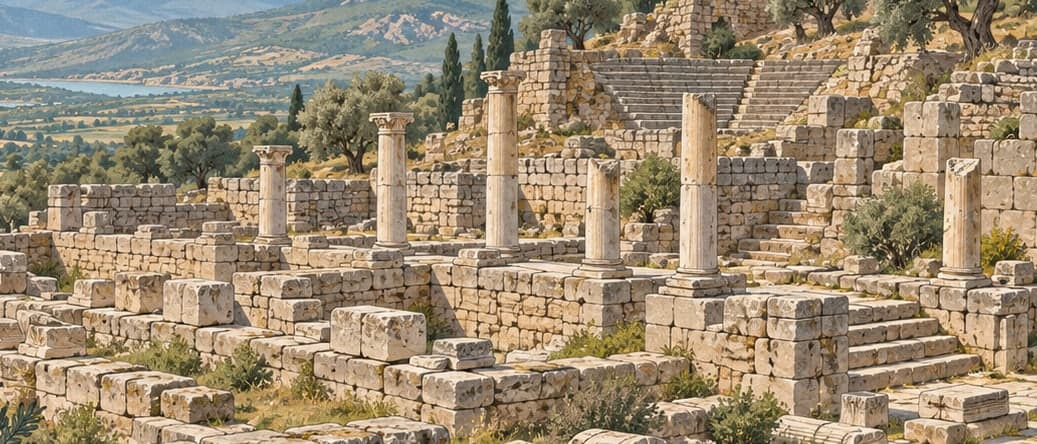
The most important building still standing at Alinda is the agora. Rectangular in plan, it has on its southern side a market building whose upper floor was laid out as a stoa. The structure runs east to west and rises three storeys.
The theatre stands on the south-western skirt of the acropolis. It was set into a natural slope, and its seating, facing south-east, is well preserved. The stage building has collapsed entirely. The theatre is Hellenistic in character and remained in use in the Roman period with additions.
On the acropolis only the foundations of two temples survive, enough to show their plans. Carian-type sarcophagi standing among the houses of Karpuzlu are evidence that the necropolis of Alinda was concentrated on the southern skirt of the city.