Guide
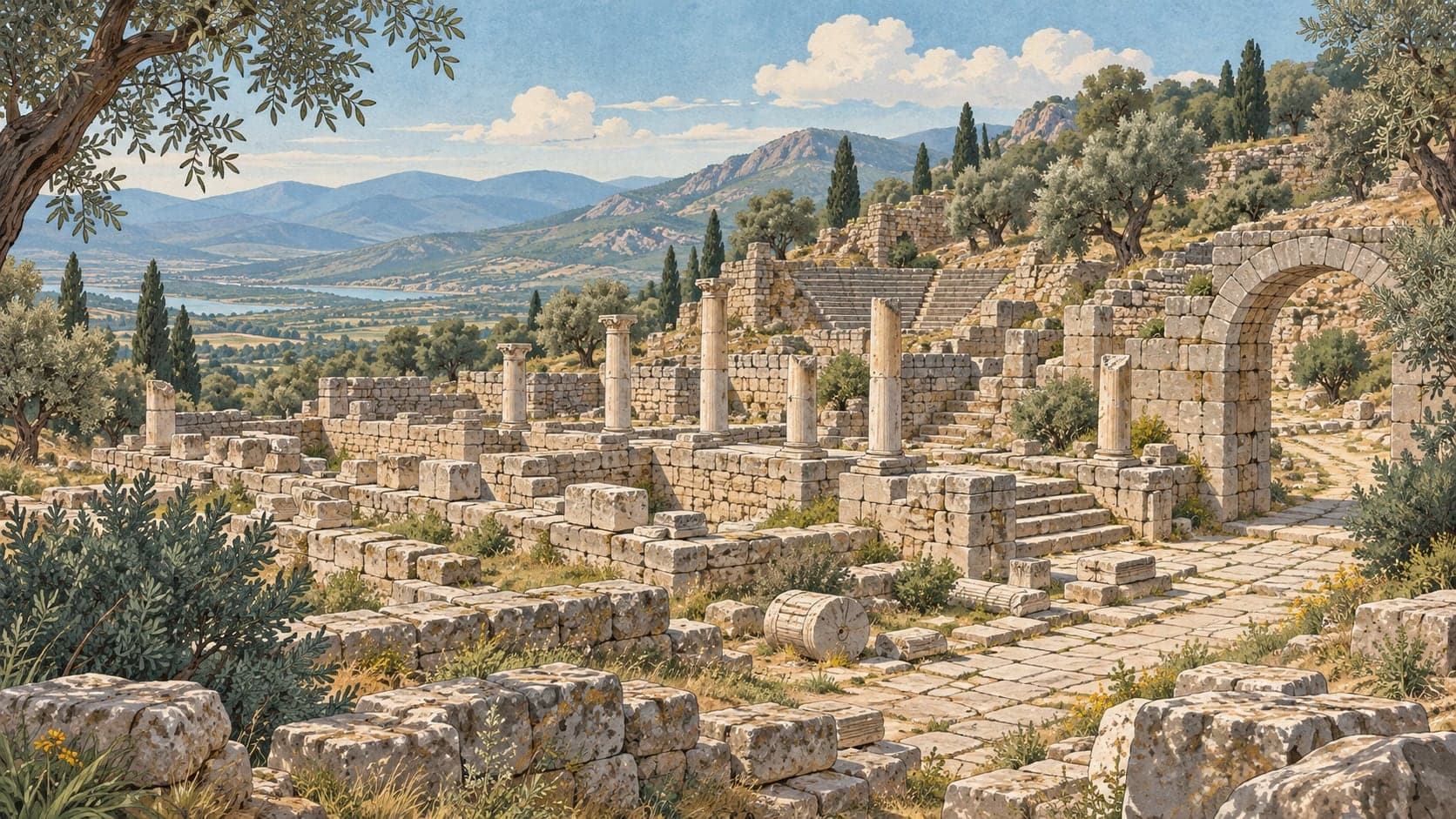
The ancient city of Alabanda lies within the bounds of the village of Doğanyurt in the Çine district of Aydın; Araphisar, where the city stands, is a quarter of that village. The site spreads over the slopes of two hills, spurs of Karadağ, four kilometres west of the Çine stream — the ancient Marsyas — and runs north towards the Çine plain. The road to Alabanda is surfaced and passes through the middle of the ancient city on its way to Alinda.
The name comes from Carian, in which ala means horse and banda a race. The Byzantine writer Stephanus records that the city was given the name because Alabandos, son of King Kar, had won a horse race. Cicero, in his work on the nature of the gods, says instead that the city took its name from the Carian god Alabandos.
Alabanda is not mentioned when Alexander the Great came into Anatolia, and the first accounts of it date from the end of the third century BC, when a Seleucid king gave the city the name Antiochia of the Chrysaoreis. An inscription found at Delphi records that the Amphictyonic Council, at the request of Antiochos III, decided on the inviolability of Alabanda and that under that decision the city was dedicated to Zeus Chrysaoreus and Apollo Isotimos.
The city was destroyed by Philip V of Macedon before the battle of Magnesia in 190 BC. After that battle, under the Peace of Apameia of 188 BC, Lycia and Caria were left under Rhodes, and Alabanda naturally shared their fate; Rhodes, however, had little influence in the city and kept only a priest of Helios there. In the war between Mylasa and Rhodes in 167 BC, Alabanda acted as a free city and fought alongside Mylasa against Rhodes. A Roman historian records that in 170 BC the people of Alabanda sent envoys to Rome with a gold crown weighing twenty-three kilograms and a great many gifts.
Alabanda first struck coins in the third century BC, shortly before the city became Antiochia of the Chrysaoreis. Minting stopped from time to time but continued into the Roman imperial period. The coins carry a winged horse, which is probably connected with the founding myth of the city.
After Rome took full control of Anatolia in 70 BC, Alabanda was joined to the province of Asia. When Mark Antony declared Ephesus the capital of the province in 48 BC, Alabanda became a regional centre, with Miletos, Priene, Tralleis and Nysa attached to it. The city was on good terms with Rome in the first and second centuries BC, and in AD 22 Tiberius granted it inviolability once more.