Guide
The mosque stands in the centre of Balıkesir, built in 1461 by Zağnos Paşa, one of the viziers of Mehmed the Conqueror. Of the complex — mosque, tomb and bath — only the bath has survived in its original state. The mosque and the tomb collapsed in 1897 and were rebuilt in 1908 by Ömer Ali Bey, the mutasarrıf of Balıkesir.
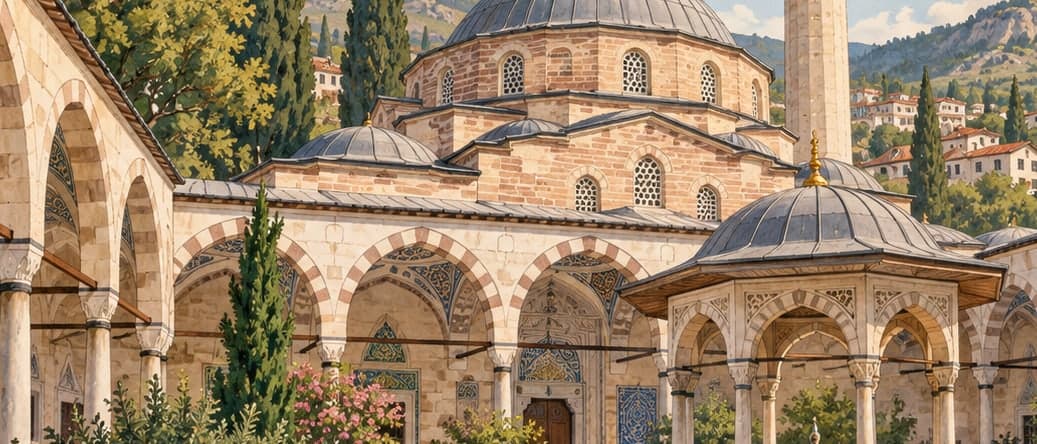
The mosque is square in plan, built of dressed and cut stone, with a central dome resting on four piers at the middle and four corner domes around it. There is no porch for latecomers; the interior is entered through double wooden doors on the north, east and west. On three sides there are canopies with wooden ceilings on square marble columns, under a sloping lead-covered roof.
The wooden women's gallery runs the length of the north corridor, resting on six fluted wooden columns and screened with lattice. The mihrab is among the finest examples carrying the features of late Turkish art. The minaret stands at the north-west corner, and in the courtyard are the tomb, the burial enclosure and the ablution fountain, with a sundial to the south of the courtyard.
One day here is recorded in detail. On 7 February 1923, during his tours of the country, Mustafa Kemal Paşa prayed the noon prayer in this mosque with a large congregation and gave an important speech. After the prayer and the mevlit read for the souls of the dead, he climbed a few steps of the minbar so that the whole congregation could see him; the text of that speech hangs today on the outer wall of the mosque.