Guide
The Van Museum has its beginnings in a store set up in 1932 to keep the movable cultural property of Van in one place. As the store filled, a museum office was created in 1945, and this became a museum directorate in 1972.
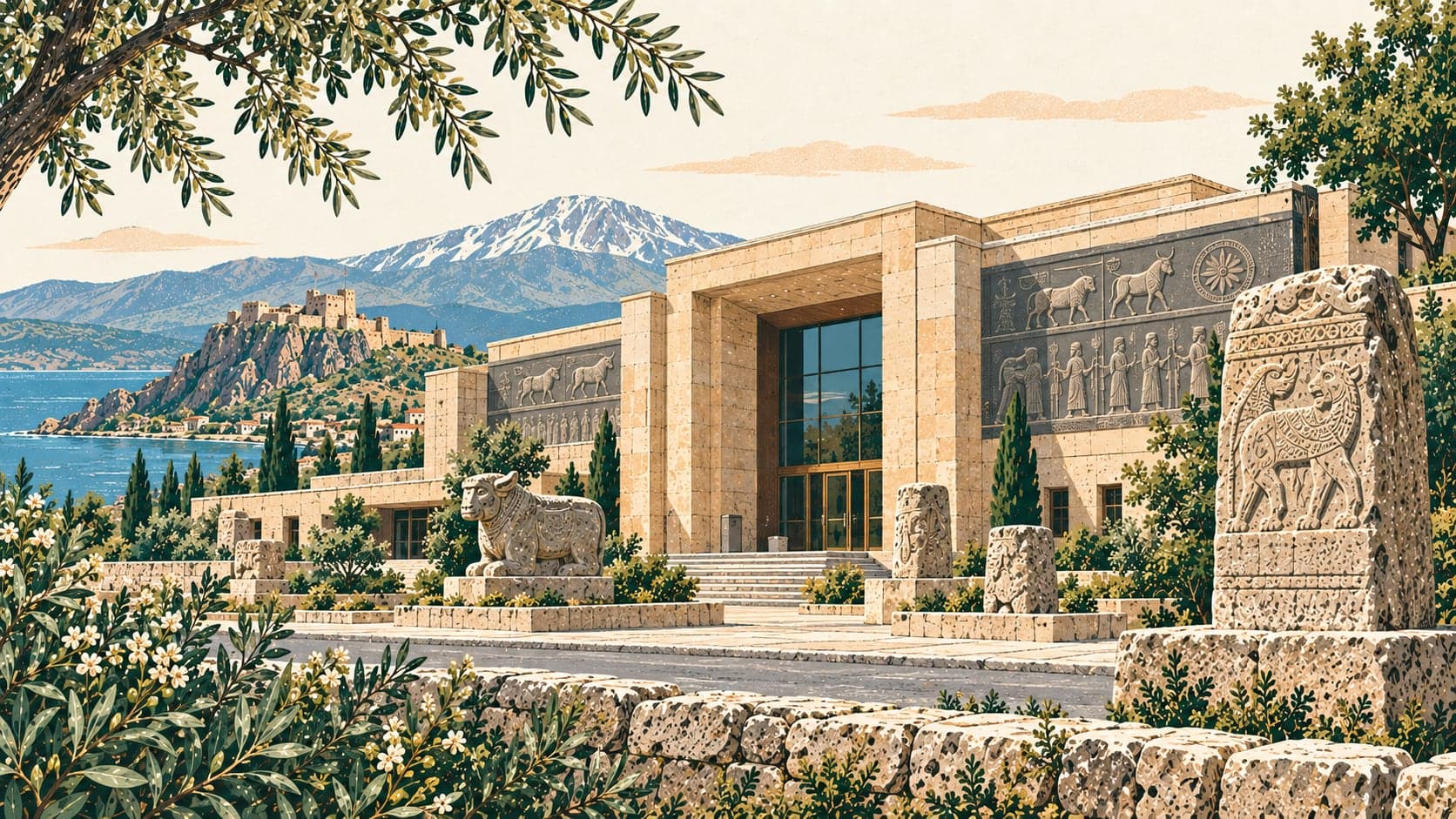
The old museum building was damaged in the Van earthquakes of 2011. Between 2012 and 2015 the provincial governorship had a new building put up on level ground north-east of Van Castle, a single-storey structure in a contemporary manner designed by the architect Bahadır Kul. Work on the displays began in 2017 and was finished in August 2019, and the new building opened on 27 August 2019.
The museum covers thirteen thousand square metres and holds twenty-three display halls. Alongside the objects there are reconstructions showing how the civilisations that ruled in Van lived and how they fought.
The inventory runs to forty-five thousand objects, of which 2,542 are on display. Nine of the twenty-three halls are given to the Urartian period, and the museum is described as the richest in the world for Urartian work.
The region was also an important place of settlement in the Roman, Byzantine, Seljuk, Akkoyunlu, Karakoyunlu and Ottoman periods, and finds, coins and ethnographic objects of those periods are shown here as well. Among the ethnographic material is a collection of woven work made up of kilims from the Van and Hakkâri region.
Two of the Urartian pieces stand out. One is a bronze plate showing a war chariot, identified as part of a horse breastplate; it is the first such Urartian breastplate piece found carrying a battle scene and is thought to date from the eighth century BC. The other is a stamp seal of white marble whose face shows Gilgamesh as master of animals, a subject not often met with in Urartian work and seen here for the first time on a stamp seal of theirs. The museum also holds thirty-nine Ottoman seals.