Guide
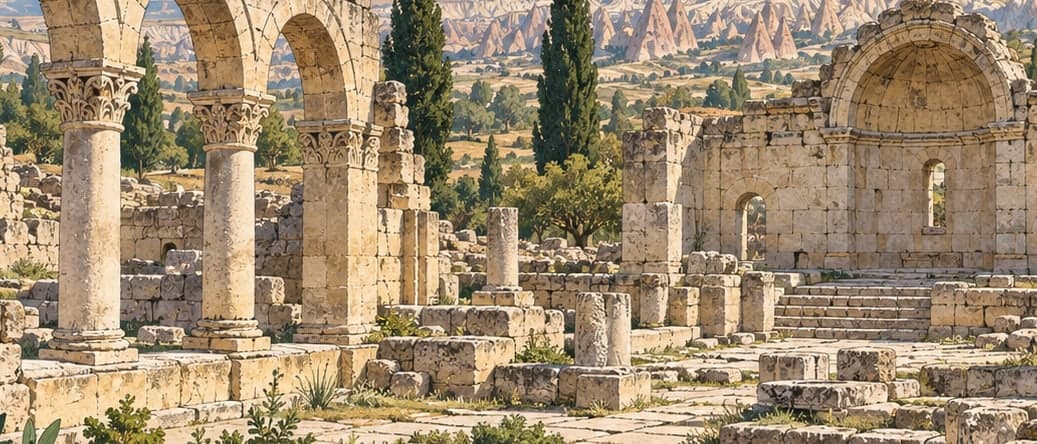
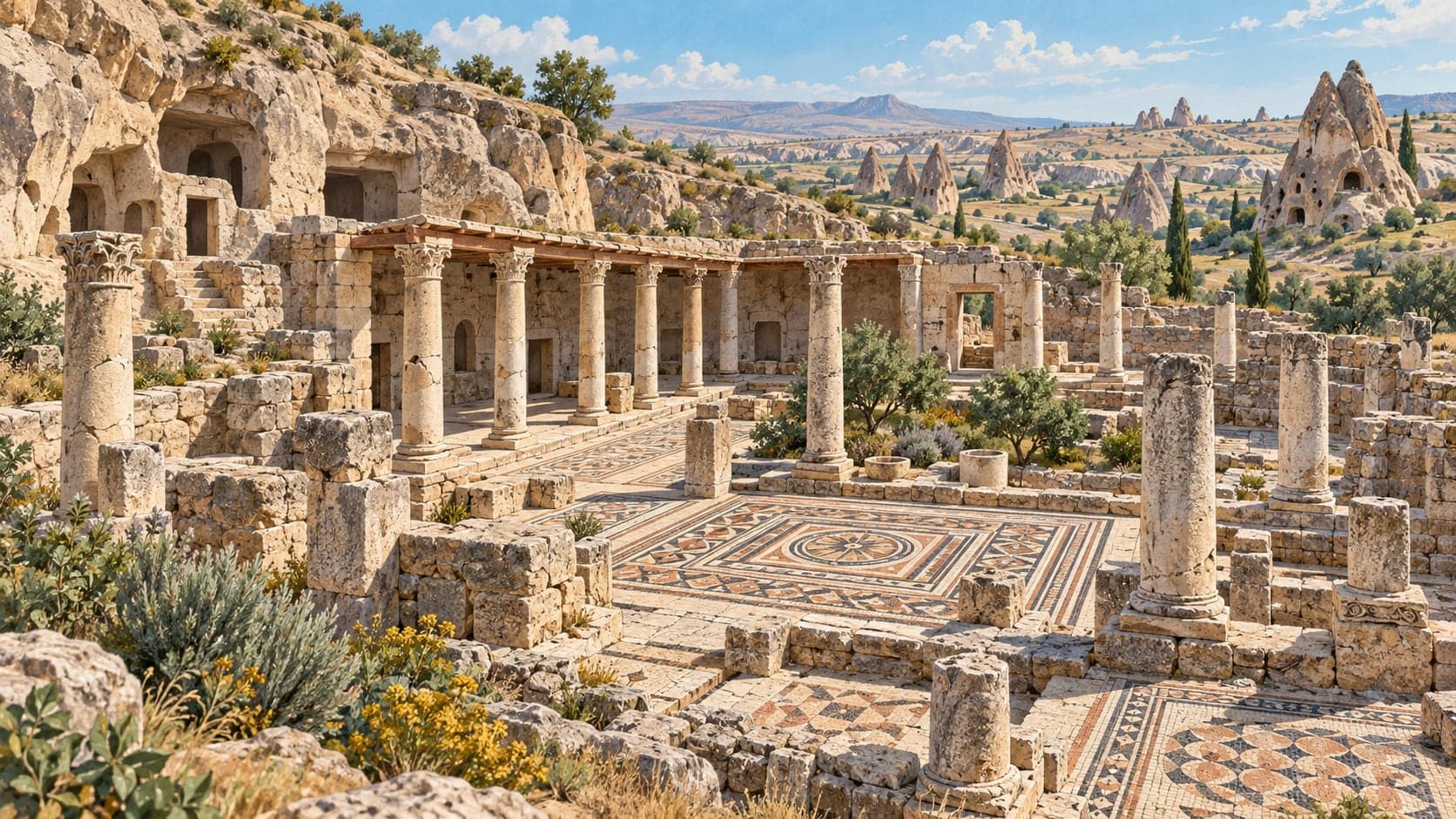
Sobessos sits among low hills on the southern side of the Damsa valley, inside the boundaries of Şahinefendi village about 25 kilometres from Ürgüp. What survives here is unusual for Cappadocia: not rock-cut chambers but the masonry of a small country town, laid out with streets, a bath and mosaic floors. Evidence for its history is thin, and the Ministry's own account is careful to say so. On present archaeological evidence the place began to function as a modest rural settlement in the 4th century AD, grew as Christianity took hold in the region, and by the reign of Leo VI (886–912) was being named as the seat of a bishop.
The oldest building uncovered so far is known as Villa I, and its three lives can be read one on top of the other. It began as the house of a local landowner: a rectangular plan fronted by a colonnaded portico, entered through a door on the north, with rooms wrapped in an L around a courtyard running along the south-east. Its floors were laid with geometric mosaics, and those mosaics — along with the general plan — survived everything that followed. After the 4th century the house became a church, a change now traceable only in a handful of architectural fragments found in its atrium. By the 7th century it had been reduced to a chapel, an east–west room put up inside the older walls from reused blocks with little care. From the second phase onwards the ground inside and outside the building was given over to burials, and many of the graves around Villa I and the adjacent cemetery chapel still carry their distinctive carved lids.
The bath block is thought to be contemporary with the villa and follows a variant of the Anatolian row-type plan, its rooms set out in an L. Running west to east are the caldarium, the tepidarium and two cold rooms; running north to south are the changing room and the steam room. Here too the floors are mosaic. The best-known panel is a pair of sandals set at the threshold of the second cold room — a visual instruction, in effect, about where shoes were left. In the changing room, damaged but still legible, circular panels framed by a guilloche border hold geometric and plant ornament. Beyond these two buildings the excavated area includes a cluster of houses served by a planned system of streets and lanes.
The site lies at Şahinefendi, in the Ürgüp district, and is reached by the village road; the Ministry's page gives the address as 50400 Şahinefendi/Ürgüp/Nevşehir. It is far enough from the Göreme–Avanos circuit to be quiet, and because the remains are low and horizontal rather than carved into cliffs, they reward slow walking and good light more than they reward a quick stop. The account above is based on the Ministry's page, written for it by Assoc. Prof. Bilsen Şerife Özdemir of the Department of Archaeology at Nevşehir Hacı Bektaş Veli University.