Guide
What is told about the founding of Miletos comes from stories rather than evidence, and the museum's own text says as much. Pausanias gives two. In the first, the land was called Anaktoria under a local ruler named Anax and for two generations after him; when Miletos arrived with a Cretan force, both the region and the city took his name, and the Carians who already held the land joined with the Cretans in order to survive. In the second, Neleus and Medon, the sons of Kodros, fell out over the throne, and Neleus, forced to leave Athens, set out for the coast of western Anatolia and founded Miletos there.
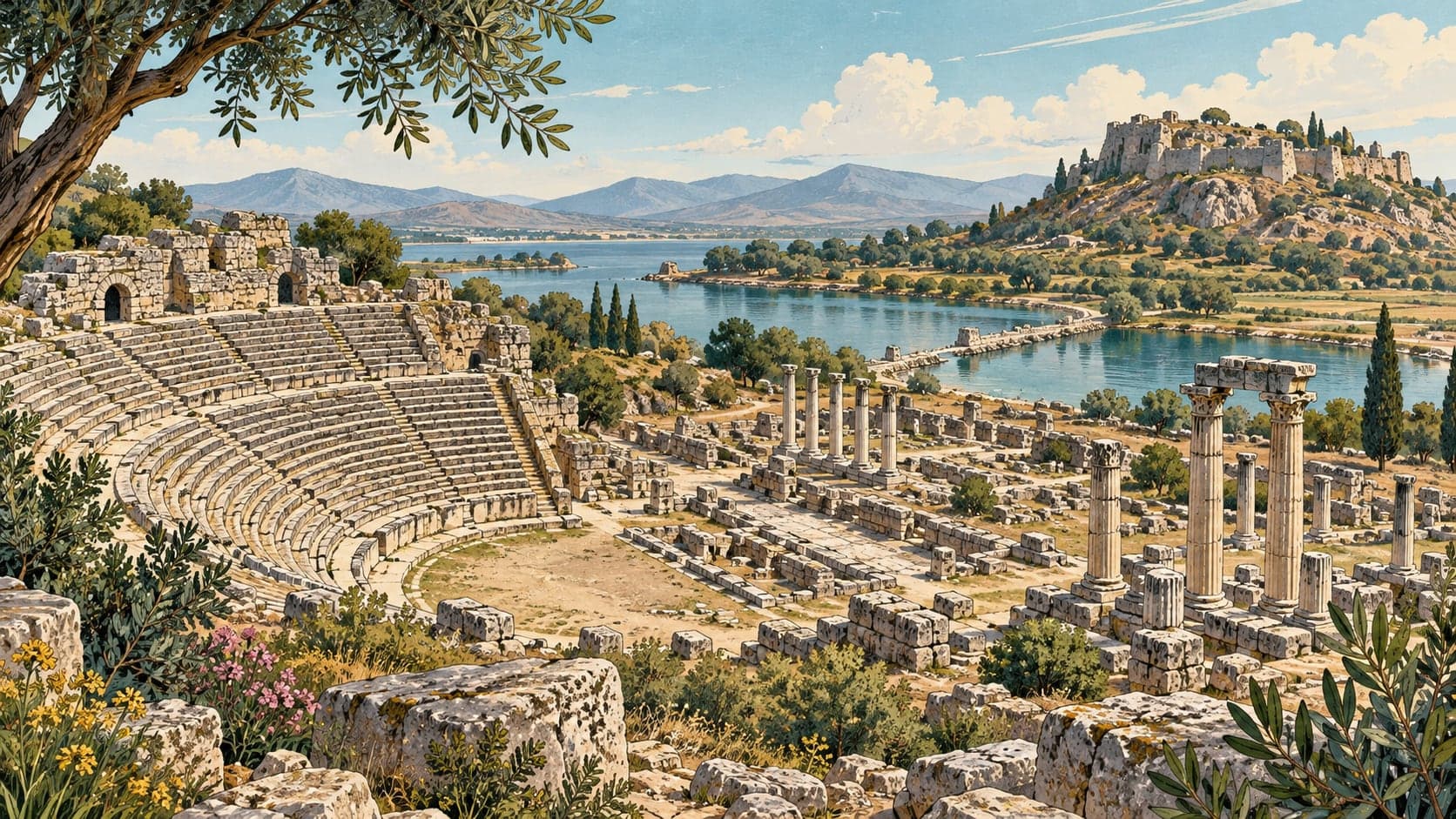
The city's documented history begins where the archaic acropolis ends. After the Persian invasion of 494 BC it was abandoned, and the Hellenistic city took shape instead around the Lion Harbour and the theatre.
Under Rome the size and the shape of the Hellenistic city were kept, but building work increased sharply. The Faustina baths, the Humei Tepe baths, the theatre, the harbour monument and harbour gate, the Capito baths, the gymnasium, the south agora gate, the west agora, the stadium and the storage buildings all belong to this period.
It was also in this period that the city began to lose the harbour that had made it, as the Büyük Menderes silted the bay up. Miletos became a bishopric in the fifth century and shrank steadily until it was confined to the theatre and the area around the castle. Under Byzantium it was known as Palatia.