Guide
The Mardin Museum is a museum of archaeology and ethnography whose collections reflect the historical and cultural wealth of the region.
The archaeological holdings cover the Bronze Age, the Assyrians and Urartians, the Achaemenid empire, the Hellenistic period, the Romans and Byzantines, the Seljuks, the Artuqids and the Ottomans. Among them are tablets, cylinder and stamp seals, cult vessels, figurines, metal awls, jewellery, pottery, coins of gold, silver and copper, tear bottles and oil lamps.
The ethnographic section holds examples of the silverwork of Mardin and the country around it — necklaces, earrings, bracelets, anklets, brow ornaments and hair ornaments — along with old clothing, swords, sets for drinking the local bitter coffee, bath equipment, prayer beads, heating implements and copperware.
The building was put up in 1895 by Ignatios Behnam Banni, the patriarch of Antioch, as the Syriac Catholic patriarchate, with the church of the Virgin Mary on its eastern side. After serving religious purposes for a long time it was used in turn as a military garrison, as the headquarters of various political parties, as a cooperative building, as a health centre and as a police station.
The ministry bought the building from the Syriac Catholic foundation, restored it in 2000, and opened it as the Mardin Museum with the transfer of the works held in the Zinciriye medrese. The museum works out of two separate buildings, one for the museum itself and one for the administration.
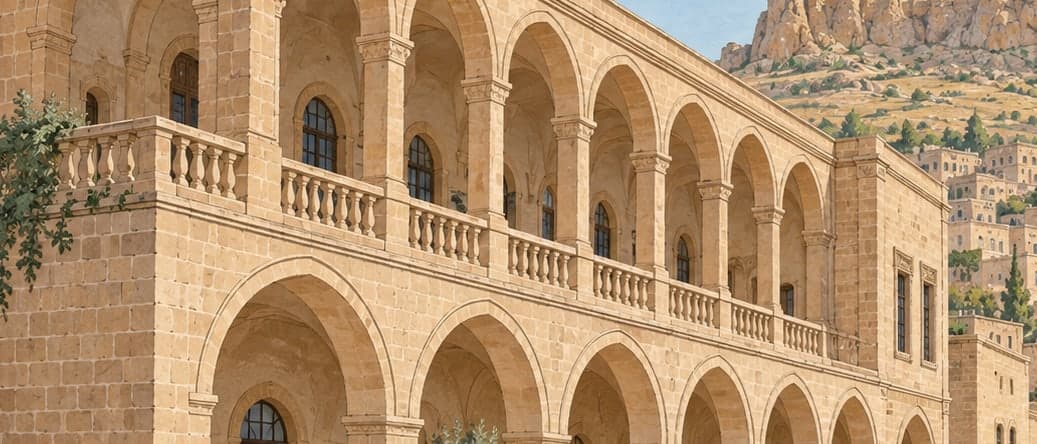
The building faces south, is laid out on a U-shaped plan and has three floors, showing the features of the traditional Mardin house. It was planned with three floors because of the steep slope of the ground and the depth of the plot.