Guide
The stone house inside the Ankara station complex known as the Direksiyon Binası went up in 1892, while the Baghdad Railway was being built, and it became Atatürk's headquarters and home: from his arrival in Ankara on 27 December 1919 it was assigned to him as both the commander-in-chief's quarters and his residence. Between 1920 and 1922 the campaign plans of the War of Independence were drawn up here, the treaty with France was negotiated and signed in the building on 21 October 1921, and the decisions to open the Grand National Assembly on 23 April 1920 and to mark that date as a holiday of national sovereignty and childhood were taken under this roof.
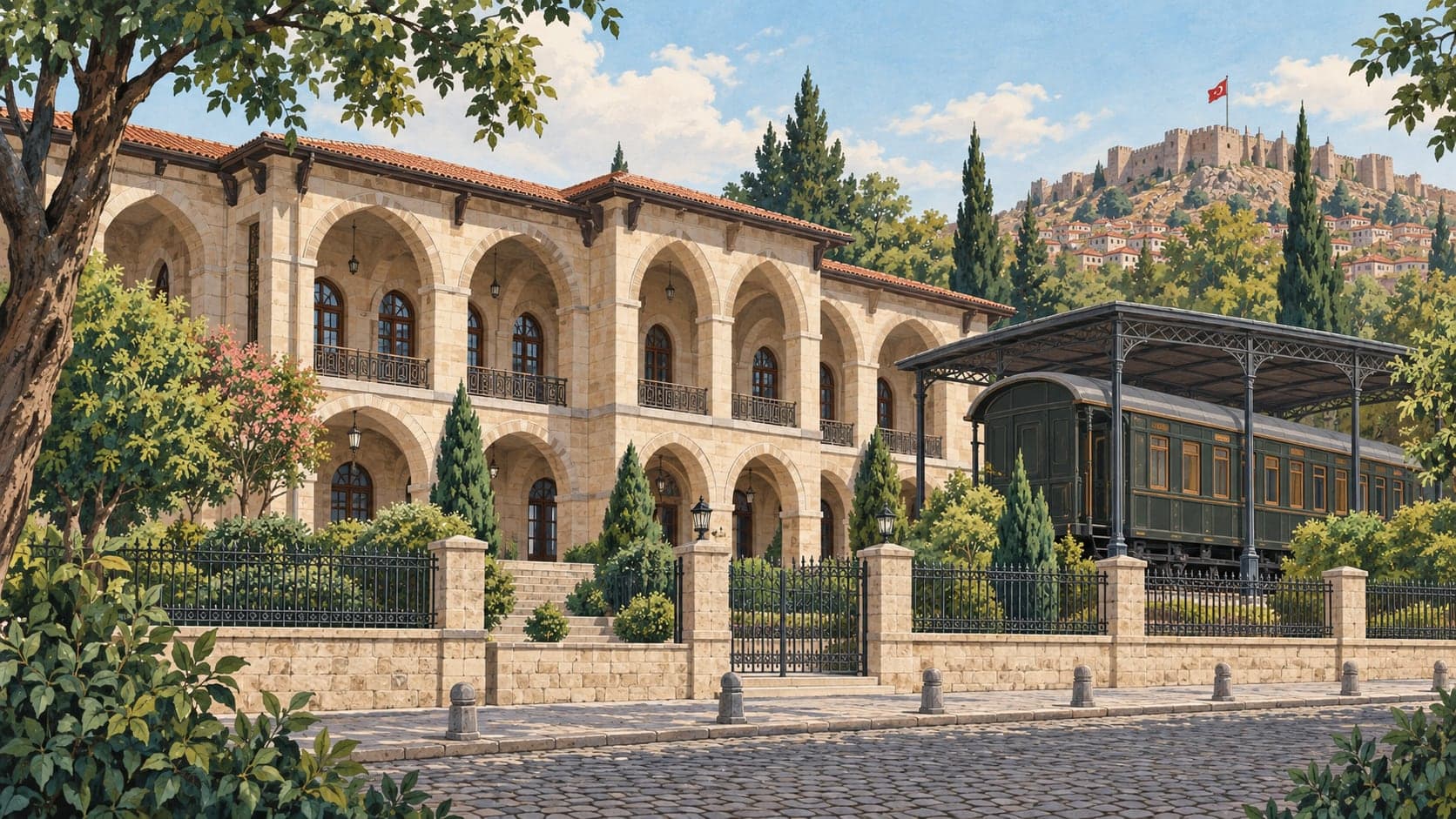
The building was rearranged and opened to visitors on 24 December 1964. According to the railway administration it was the first museum run by a state institution to hold private-museum status under the supervision of the culture ministry. The house itself is worth a look before you go in: two storeys of stone with keystone arches, stone-dressed corners and wooden eaves, and window surrounds that are the only decoration anywhere on it.
The ground floor is laid out as a railway museum. Documents reaching back to 1856 are shown alongside commemorative medals, point levers and rail samples, and silver service sets once used in dining and sleeping cars; there are Ottoman seals, diplomas, identity papers and tickets, locomotive plates and the telephone and telegraph machines that carried traffic orders. Among the singular pieces are a gilded miniature carriage presented to Sultan Abdülaziz by the British government, the sultan's mother-of-pearl inlaid desk from his private carriage, and the pick and shovel Atatürk used at the groundbreaking of the Samsun–Çarşamba line in 1925. A model steam locomotive given to Behiç Erkin, the railway's first director general, by the German railway administration stands nearby, and İbrahim Çallı's 1920 canvas of women hauling an oxcart during the war hangs here at three metres by two, still in its original one-piece frame.
A high-ceilinged staircase leads to the upper floor, which is kept as a house rather than a gallery: Atatürk's reception room, his study and his bedroom, and the room of Fikriye Hanım. Personal belongings of both are displayed, including material given to the museum by Fikriye Hanım's nephew Hayri Özdinçer — the 1924 newspaper carrying her death notice, her registry papers, her family tree, photographs, a bedspread and an ud — with the furniture left as it was.
Getting there
The museum sits in the TCDD station grounds at Ulus, and any public transport running towards Ulus will put you within walking distance.