Guide
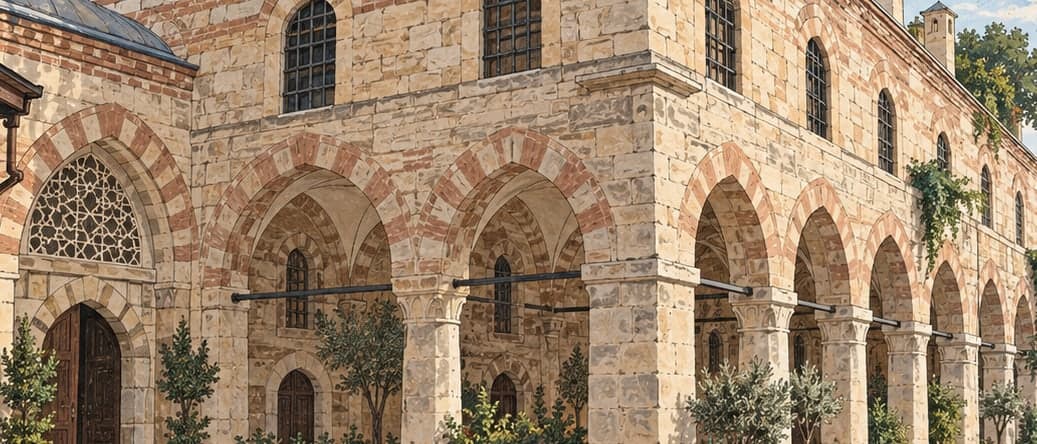
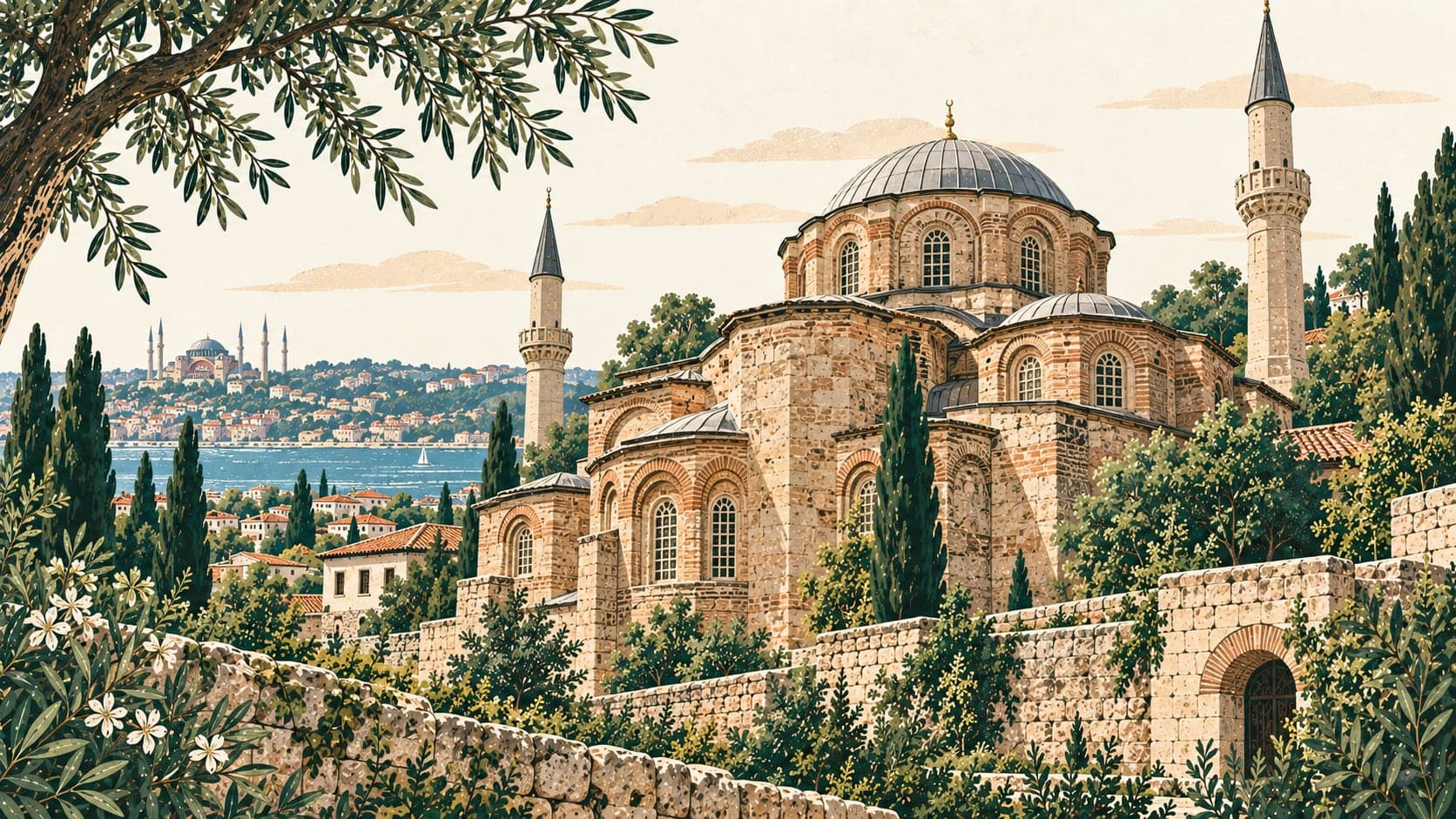
The Kariye Mosque, formerly the Church of the Holy Saviour in Chora, stands in the Edirnekapı quarter of the Fatih district of İstanbul, about a hundred metres from the still-standing Theodosian walls. Under the Eastern Roman empire it was the centre of the Chora monastery, a large group of buildings of which only the church survives. Its present state is the result of repairs made in the Ottoman period and in the second half of the twentieth century.
What it is today matters for a visit. The church went on serving as a church for fifty-eight years after the conquest of the city, was turned into a mosque in 1511, was declared a national monument in 1945, and became a museum under the Museums Administration by a cabinet decision in 1948. It was one of the most visited museums in Türkiye. In 2019, following an annulment by the Council of State, it was transferred by the president to the Directorate of Religious Affairs, and on 6 May 2024 it was opened for worship.
It is known throughout the world for its mosaics and frescoes, and it owes their survival to the way it was converted. When the church became a mosque, the Christian symbols, the inscriptions and all the frescoes and mosaics were covered with a thin coat of paint and lime wash rather than destroyed, and so came down to the present.
The building's history reaches back to the sixth century, though its date is not certain. Some sources hold that it was first built in 536, in the reign of Justinian I, by a Saint Theodore, the uncle of his wife Theodora, about whom little is known in detail. It is claimed that the ground it stands on had become important as a necropolis in the fourth century with the burial there of the relics of Saint Babylas, martyred at Nicomedia in the early Christian centuries — though others hold that Babylas was of Antioch rather than Nicomedia and that these claims were made only in later periods. Because it lay outside the city walls the monastery was given the Greek name Chora, meaning the countryside or the land beyond the city. When this first building was thrown down, still unfinished, by the earthquake of 6 October 557, the emperor had a larger monastery built on the site.
The monastery first appears in written sources in the eighth century, with the burial here of the patriarch Germanos I. It was damaged during iconoclasm and repaired more than once. After a council in 843 confirmed the decisions of the Second Council of Nicaea and the cult of icons was permitted again, the church was enlarged and three new chapels added in a great building campaign carried out by Michael Synkellos, who had been appointed abbot.
In the eleventh century, when the Komnenian dynasty chose to use the Blachernae Palace at Edirnekapı rather than the Great Palace, the church of the Chora monastery gained in importance by its nearness to it. Maria Doukaina, mother-in-law of Alexios I, took the ruined monastery under her protection and had it rebuilt, dedicating it — as the Komnenoi always preferred — to Christ the Saviour. The patriarch Kosmas I resigned after the restoration and was buried here when he died. About half a century later, for reasons unknown, the monastery again needed large-scale repair, and in 1120 Isaakios Komnenos, the youngest son of Alexios I, rebuilt most of it; in the rebuilding the cross-in-square plan was changed to one with a ciborium.
The monastery was ruined in the Latin occupation of 1204–1261. After the Palaiologoi retook the city the Blachernae Palace became the emperors' residence and the Chora gained importance again; the church underwent a great repair after its dome collapsed. Theodore Metochites, a Byzantine aristocrat appointed Grand Logothete — the highest office in the state bureaucracy after the emperor — under Andronikos II, renewed the monastery near which he lived. Among the Byzantine aristocracy, building or repairing a religious institution was seen as prestige in this world and investment in the next. Metochites, a great scholar and humanist, was named ktetor, or founder, of the monastery by Andronikos II Palaiologos and spent his fortune on its repair. The outer narthex and the parekklesion, the side chapel, were added in this period, and between 1310 and 1317 their interiors were decorated with the finest of the frescoes and mosaics. His work was finished before 1317. He endowed his famous library on the foundation and kept private rooms within the monastery. Falling from favour around 1328 he was exiled, and in 1330 was allowed to return and live there as a monk under the name Theoleptos; when he died on 13 March 1332 he was buried in the funerary chapel he had prepared for himself.
After that thorough restoration the Chora saw no significant change until the city was taken by the Ottomans. The last event involving it recorded in Byzantine sources is the bringing here, during the siege of 1453, of the icon of the Virgin kept at the Hodegon monastery and believed to protect the city; some sources hold the icon was destroyed during the conquest. The building itself took no damage in the conquest. It was converted into a mosque in 1511 by Atik Ali Paşa, one of the grand viziers of Bayezid II; in the conversion the mosaics and frescoes on the walls were covered with plaster, a minaret was built in place of the bell tower at the south-west corner, and a marble element was added at the south-east.