Guide
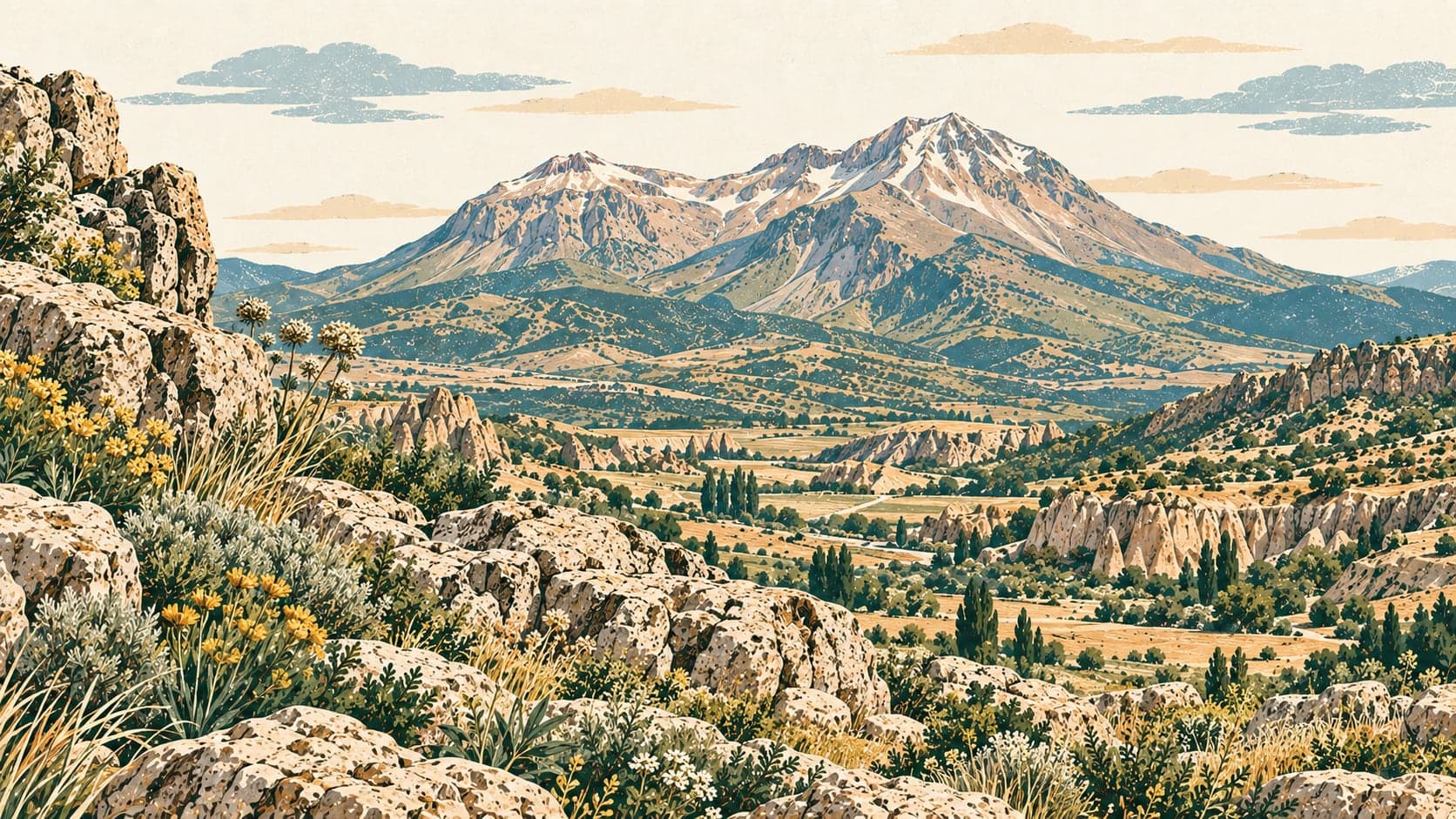
Hasan Dağı is a volcanic mountain of 3,268 metres standing across the provincial boundary of Aksaray and Niğde. It has two large craters, Büyük Hasan and Küçük Hasan, and most of the neighbouring Melendiz mountain was formed by the lavas that came out of them. The main cone, Büyük Hasan at 3,268 metres, rises abruptly from the Aksaray plain to its north-west, the Obruk plateau to its west and the flats of the Bor plain to its south, and stands over them like a sombre natural monument. Its summit is a typical crater with a crater lake in the floor. The twin cone just south-east of it, smaller and lower, is Küçük Hasan at 2,844 metres, and its summit too is a typical crater.
Büyük Hasan keeps a well-preserved main crater ringed by parasitic cones. The summit of Küçük Hasan is a somma: what remains of the steep walls that formed the edges of the older caldera, enough to make out the shape of the first crater. The andesite and basalt lavas that came from that crater flowed north over a wide area, and the tuffs reached as far as the Kızılırmak.
The mountain is a typical volcanic cone built of material erupted in several phases: andesites form the skeleton of the cone, with basalt flows above them, and in the most recent period young basalt flows and basalt cinder cones emerged from fissures in the older lava. There is a crater over the main vent at the summit and parasitic cones on the eastern slopes, and Quaternary erosion has cut the slopes into valley-like gullies. Nearby stands Melendiz Dağı, which resembles it in date, structure and form; Karacadağ, Meke Dağı and Karadağ south of Lake Tuz are further volcanic cones on the same line as Erciyes and Hasan Dağı. Hasan Dağı is among the youngest volcanic mountains in Türkiye, with fresh and characteristic volcanic forms, and it has slept since historical times. After an earthquake of magnitude 5.3 south-west of the mountain on 20 September 2020, pressurised gas emissions — fumaroles — appeared on it, and surveys in November 2021 found a rise in the level of the magma.
Oak forest covers the mountain to about 1,750 metres. Various Turkic peoples live on its skirts and around it, the Yörüks above all, and the Roman town of Nora lies at its foot. The people of Çatalhöyük gathered obsidian from around Hasan Dağı and probably traded it with people of other settlements for luxury goods; obsidian mirrors and flakes have been found. The mountain's importance to them may also be read in a wall painting sometimes described by art historians as the first landscape, which some take to depict Hasan Dağı rising beyond the houses of the settlement.