Guide
İmbriogion was a Roman city, and its remains lie in the village of Demircili in the Silifke district of Mersin. The city is known for its monumental tombs of one and two storeys, dated to the second century AD.
The first of them is a two-storey building whose roof has collapsed, with four columns on its front carrying Ionic capitals below and Corinthian above; a rock tomb stands beside it.
About three hundred metres further on, two monumental tombs standing side by side on the right are the most striking things here. These two-storey buildings, with the craft in their architectural ornament and the detail of their inscriptions, reliefs and animal sculpture, show that the tomb belonged to an important family; two human busts are carved in relief on it. The single-storey tomb to their left carries all the features of the Corinthian order.
East of the road there is another monumental tomb known as Sivri Kale, remarkable for its pyramidal roof closed with slab-shaped stones; the construction inside it differs from the tombs described above. Toward the edge of the village, on the left of the road, stands one more: its roof is again covered with square stone slabs, its waterspouts take the form of lions' heads, and shield reliefs appear on the front and rear pediments. Its inscription has fallen to the ground and a sarcophagus stands in front of it.
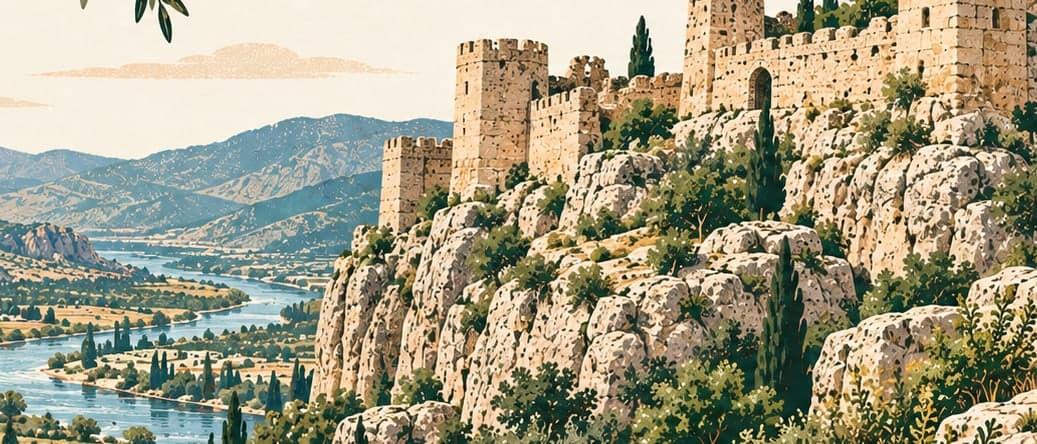
These tombs belonged to the leading families of ancient İmbriogion. Four of them can be seen right beside the Silifke–Uzuncaburç road, and on the hill beyond them are further remains of the site and a tower.