Guide
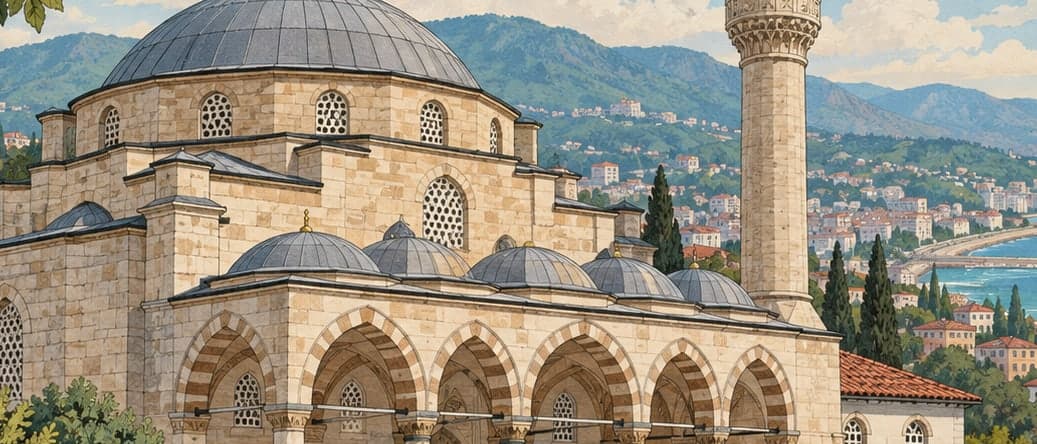
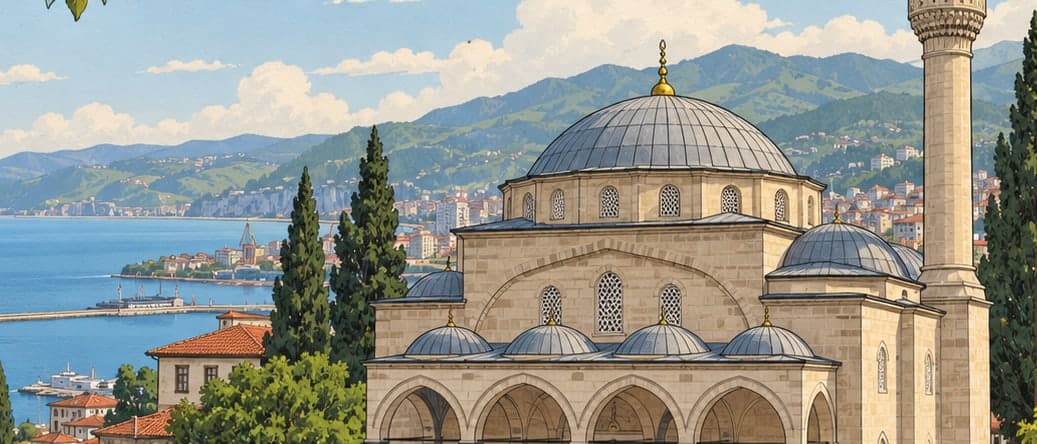
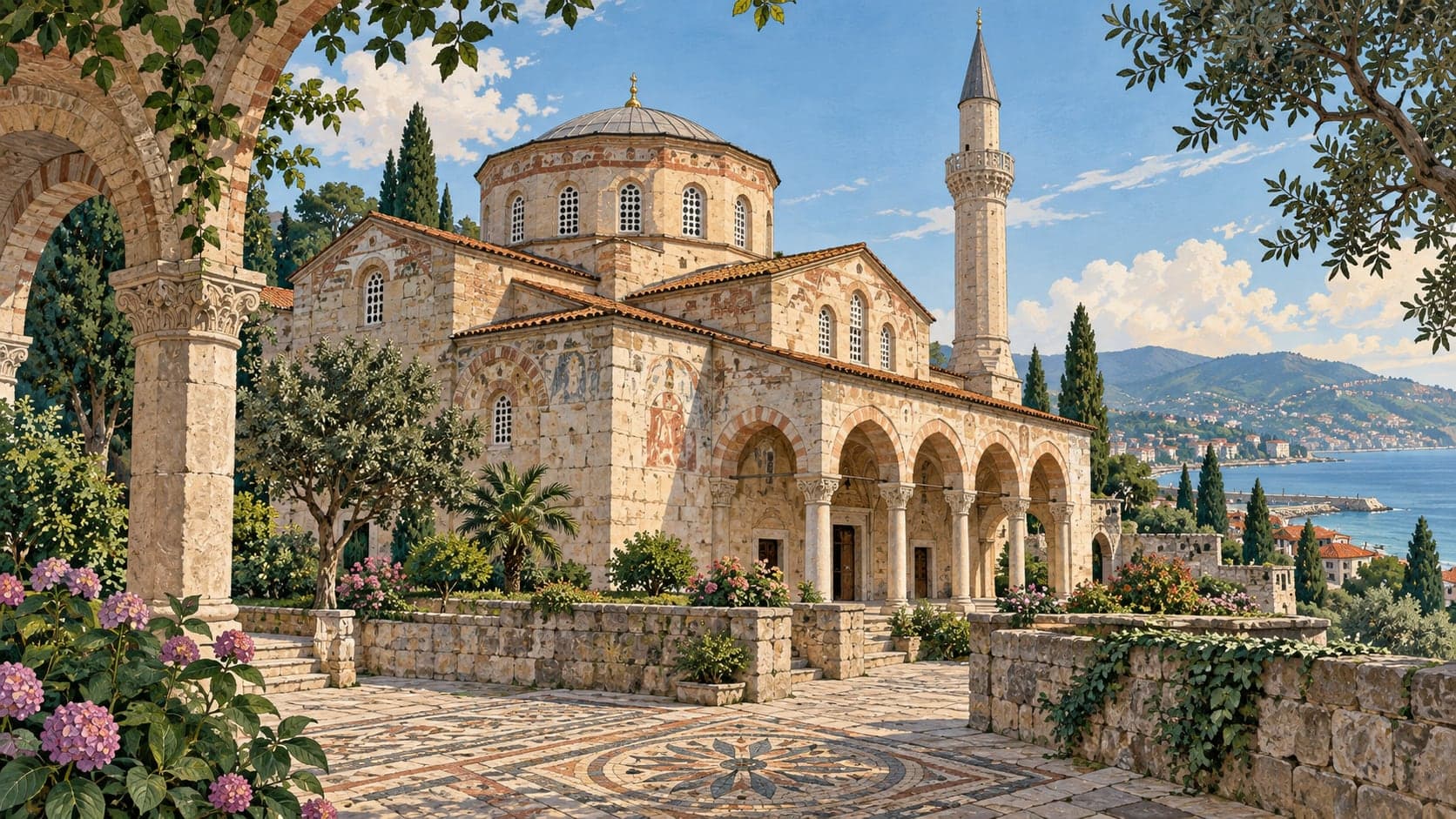
This is the Ayasofya of Trabzon, not the one in İstanbul. It was built between 1250 and 1260 under Manuel I Komnenos, one of the rulers of the Empire of Trebizond, and is a good example of a late Byzantine church. After Mehmed II took Trabzon it became a mosque and passed into a pious foundation. It was restored and turned into a museum in 1966, and has served as a mosque again since 2013.
The building mixes three traditions: provincial Byzantine, the onion dome of Georgia, and Seljuk work in stone. The plan is a cross with closed arms under a dome on a high drum, with porticoed entrances on the north, west and south. Around the main dome the spaces are covered with vaults of varying kinds, and the roof is tiled at several heights.
Under the main dome there is a floor mosaic in opus sectile, worked in marble of nine different kinds. It was covered over with timber rather than altered, and has survived untouched. Inside, a narthex leads into three aisles, each ending in an apse to the east; the central apse is round within and five-sided without. The drum was given twelve sides for the twelve apostles, who are painted on it, and the dome rests on four columns pierced by twelve round-arched windows with wooden frames.
The south front is the most worked. A frieze carved along it tells the creation of Adam and Eve, and the keystone of the arch carries the single-headed eagle of the Komnenos dynasty, which ruled in Trabzon for 257 years; a similar eagle appears outside the main apse on the east. Centaurs and griffins, doves, square panels with a star and crescent at their centre, and medallions filled with plant motifs run across the same face. The medallions on the north and west porticoes and the muqarnas niches on the west are Seljuk in character.
The frescoes were uncovered between 1957 and 1961 by the Russell Trust of the University of Edinburgh, who cleaned off the plaster over them. Parts have survived badly and those in the south narthex are gone altogether. The subjects are taken from the Gospels: Christ Pantocrator at the centre of the dome, an inscription band beneath him, then a frieze of angels, with the twelve apostles between the windows and scenes of the Nativity, the Baptism and the Crucifixion below.