Guide
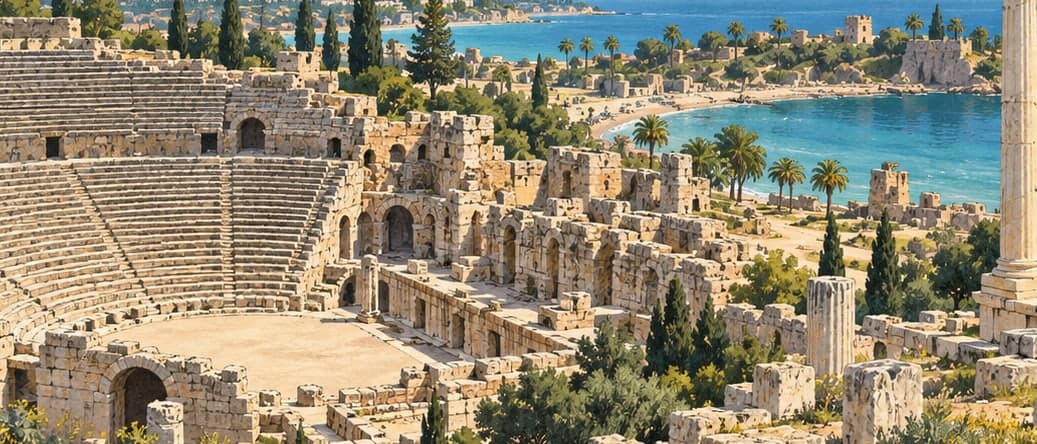
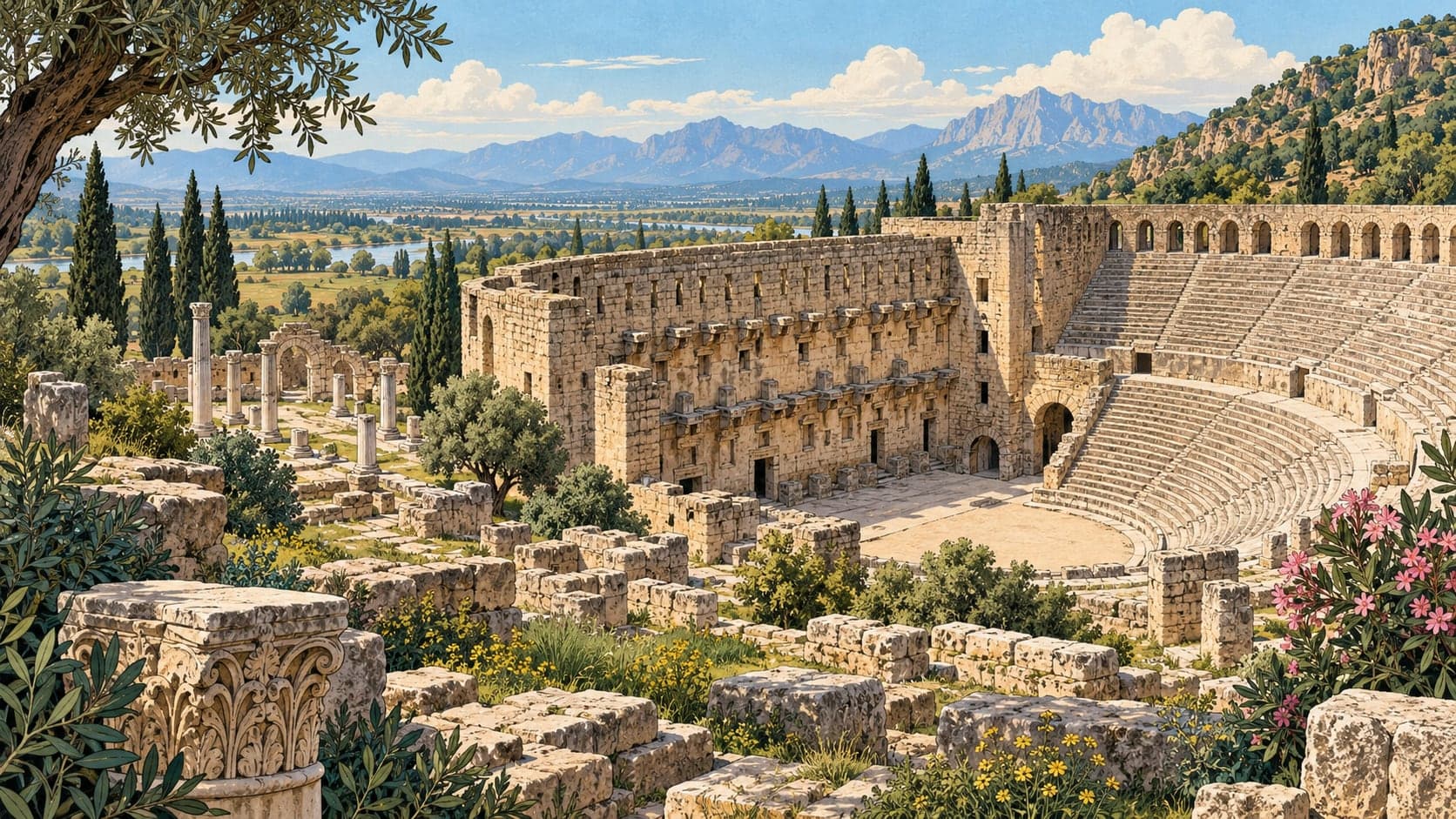
Aspendos is famous for one building: the Roman theatre, which the ministry calls the best preserved not only in Anatolia but in the whole Mediterranean world. The city sits on the flat of a hill near the Köprüçay, the ancient Eurymedon, one of the region's largest rivers — and it owed both its access to the Mediterranean and its prosperity to that river and the fertile land around it.
The theatre was built under Marcus Aurelius, between AD 161 and 180, by the architect Zenon, son of Theodoros. Greek and Latin inscriptions at either side of the entrance show it was paid for by two wealthy brothers of the city, Curtius Crispinus and Curtius Auspicatus. It holds fifteen to twenty thousand people, and was dedicated to the gods and to the emperors of the day.
Part of why it still stands is medieval. Seljuk repairs are visible in the monumental gateway added to the middle of the outer face and in the dark red zigzag plaster on that face; the stage building is thought to have been fitted out as a caravanserai where Seljuk sultans lodged, and that reuse is credited with keeping it intact. Mustafa Kemal Atatürk visited in 1930 and gave instructions for its repair and return to use.
The other thing to see is the water system, which the ministry counts among the best-preserved ancient aqueducts anywhere. An arched bridge about a kilometre long runs north to south with a water pressure tower at each end; the city's water was collected in pear-shaped cisterns cut into bedrock on the hill, and in the second and third centuries AD the whole system was improved to deliver it more steadily. On the walled hilltop above the theatre lie the agora, a basilica, a monumental fountain, the council house, a monumental arch, a street and a Hellenistic temple. That a city this small struck the most widely accepted coinage in the Mediterranean and filled itself with monuments is explained, the ministry says, by its trade — above all salt from the nearby Kapria lake, still dried today for use in cotton growing, shipped down the navigable river to Mediterranean markets.